Technical Indicator

Mastering the Candles_Smoothed Indicator for MetaTrader 5
MetaTrader5
Mastering the Candles_Smoothed Indicator for MetaTrader 5

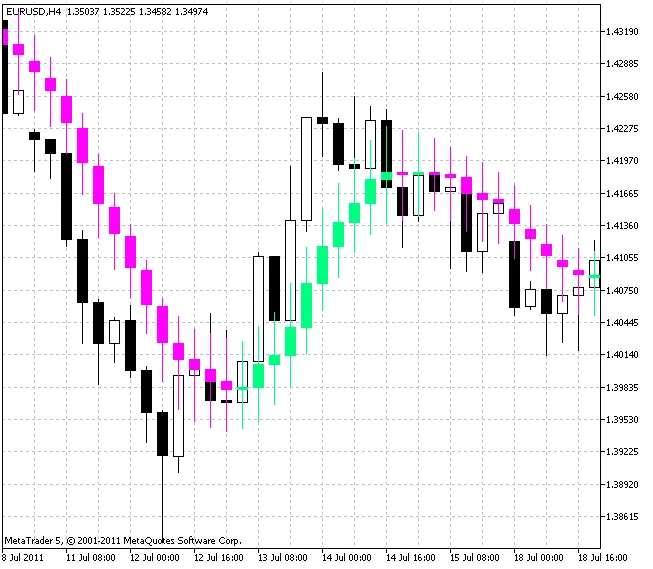
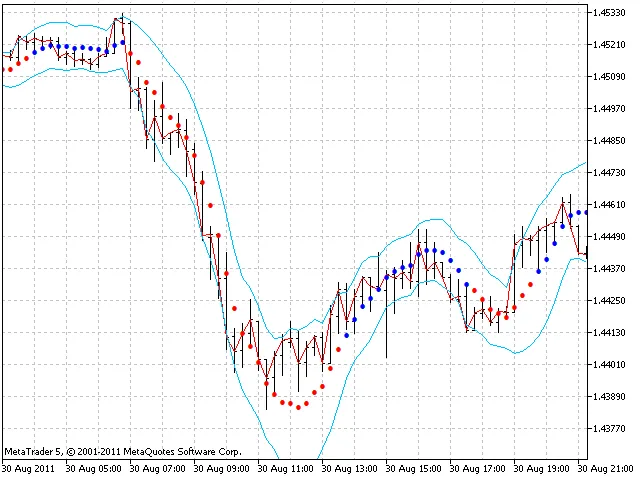
The Candles_Smoothed indicator is a game changer for traders using MetaTrader 5. It applies smoothing to every aspect of a price candlestick: the Open, Low, High, and Close. This gives you a clearer view of the market trends at a glance. One of the standout features of this indicator is its visual representation of the current market trend. The color of the candlestick reveals the trend direction, while the size of its body indicates the strength of that trend. You have the flexibility to choose from ten different smoothing methods: SMA - Simple Moving Average; EMA - Exponential Moving Average; SMMA - Smoothed Moving Average; LWMA - Linear Weighted Moving Average; JJMA - JMA Adaptive Average; JurX - Ultralinear Smoothing; ParMA - Parabolic Smoothing; T3 - Tillson's Multiple Exponential Smoothing; VIDYA - Smoothing Using Tushar Chande's Algorithm; AMA - Smoothing Using Perry Kaufman's Algorithm. It's important to note that the phase parameters for different smoothing methods have unique meanings. For instance, with JMA, the external phase variable ranges from -100 to +100, while for T3, it's a smoothing ratio multiplied by 100 for better visualization. For VIDYA, it involves a CMO oscillator period, and for AMA, it’s based on a slow EMA period. In contrast, other algorithms don’t affect smoothing with these parameters. Notably, the fast EMA period for AMA is fixed at 2 by default, and the power ratio is also set to 2. To make the most of this indicator, you'll need to copy the SmoothAlgorithms.mqh library classes into your terminal_data_folder/MQL5/Include. For a thorough explanation on how to utilize these classes, check out the article "Averaging Price Series for Intermediate Calculations Without Using Additional Buffers".

2011.11.02
Understanding the Ease of Movement Indicator for MetaTrader 5
MetaTrader5
Understanding the Ease of Movement Indicator for MetaTrader 5

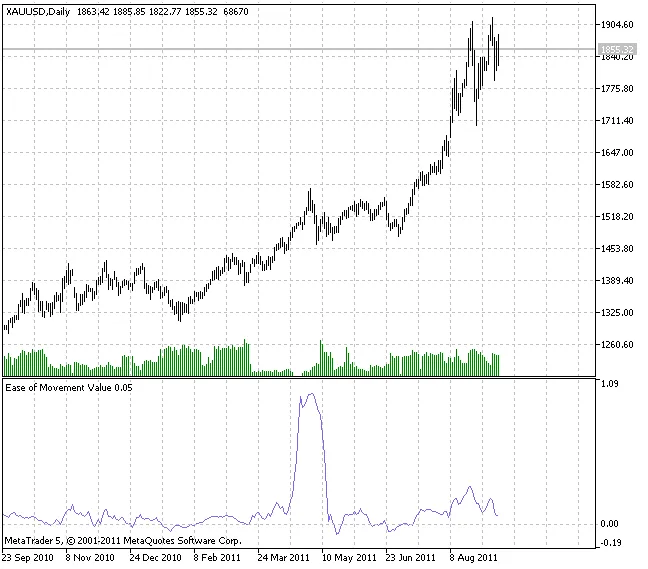
The Ease of Movement (EMV) indicator is a powerful tool in the trader's toolkit, designed to show the relationship between price changes and market volume. Originally developed by Richard W. Arms, Jr., the same mind behind the well-known Arms Index, EMV is calculated by taking the ratio of the Midpoint Move to the volume (Volume / (High - Low)). Here's the basic formula: EMV = Midpoint Move / (Volume / (High - Low)) Where: Midpoint Move = (Today's High + Today's Low) / 2 - (Yesterday's High + Yesterday's Low) / 2 Typically, the EMV values are smoothed using a moving average, with a common period set to 14 candlesticks. What Does EMV Tell You? When EMV rises, it indicates that prices have increased with low volume, hinting that a price change could be coming soon. If EMV is falling, it shows that prices are decreasing on low volume, which may also signal an upcoming price shift. A near-zero EMV suggests a "heavy market," meaning significant volume is required to influence price movements in the short term. Large positive EMV values indicate rising prices with low volume, while significant negative values suggest falling prices under similar conditions. Trading Signals Signals: A buy signal occurs when EMV crosses above the zero line. A sell signal is generated when EMV dips below the zero line. The indicator illustrates that when the price movement range is narrow and volume is "heavy," the market experiences less movement freedom. Choosing Your Smoothing Type This indicator allows you to select from ten different smoothing types: SMA - Simple Moving Average EMA - Exponential Moving Average SMMA - Smoothed Moving Average LWMA - Linear Weighted Moving Average JJMA - JMA Adaptive Average JurX - Ultralinear Smoothing ParMA - Parabolic Smoothing T3 - T3 Smoothing VIDYA - VIDYA Smoothing AMA - AMA Smoothing Keep in mind that the phase parameters for different smoothing algorithms have unique meanings. For example, JMA uses an external Phase variable ranging from -100 to +100, while T3 uses a smoothing ratio multiplied by 100 for clarity. Understanding these differences can help you optimize your EMV usage. Additionally, the indicator relies on the SmoothAlgorithms.mqh library classes, which must be placed in the terminal_data_folder\MQL5\Include. You can find detailed usage instructions in the article "Averaging Price Series for Intermediate Calculations Without Using Additional Buffers".

2011.11.02
Understanding the Demand Index: A Key Indicator for MetaTrader 5 Traders
MetaTrader5
Understanding the Demand Index: A Key Indicator for MetaTrader 5 Traders

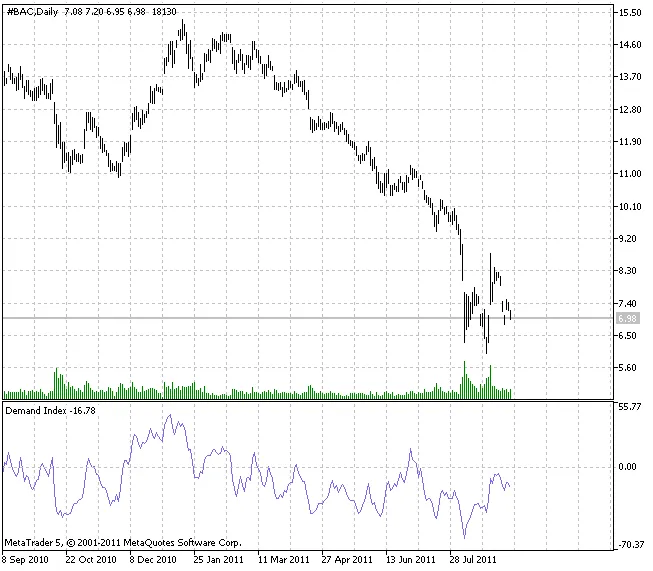
The Demand Index, crafted by James Sibbet, is a powerful tool for traders looking to analyze price and volume dynamics. This leading indicator ranges from +100 to -100, providing insights into market strength and potential reversals. It’s essential to grasp how this index operates to enhance your trading strategy. Here are six key rules to keep in mind when using the Demand Index: Divergence between the Index and price trends often indicates a weak price movement. When market activity ramps up, new price highs typically follow peaks in the Demand Index—acting as a forward-looking guide. If prices hit new highs while the Index dips below its previous peak, be wary of significant reversals—here, the Index serves as a confirming indicator. When the Index crosses the zero line, it signals a shift in trend—this is where the Index acts as a lagging indicator. If the Index hovers around the zero level for an extended period, it suggests that the current price move is weak and unlikely to sustain. Long-term divergence between price and Index values often points towards major tops and bottoms in the market. The Demand Index also offers flexibility in smoothing options, allowing you to choose from ten different methods: SMA - Simple Moving Average EMA - Exponential Moving Average SMMA - Smoothed Moving Average LWMA - Linear Weighted Moving Average JJMA - JMA Adaptive Average JurX - Ultralinear Smoothing ParMA - Parabolic Smoothing T3 - Tillson's Multiple Exponential Smoothing VIDYA - Smoothing using Tushar Chande's Algorithm AMA - Smoothing using Perry Kaufman's Algorithm It’s worth noting that each smoothing method has its own unique parameters. For instance, the Phase type for JMA ranges from -100 to +100, while for T3, it’s a smoothing ratio for better visualization. The parameters for VIDYA represent a CMO oscillator period, and for AMA, it's a slow EMA period with a default value of 2. Keep in mind that in other algorithms, these parameters might not influence the smoothing process. The Demand Index utilizes the SmoothAlgorithms.mqh library classes, which can be found in the terminal_data_folder/MQL5/Include. For a deeper dive into these classes, check out the article titled "Averaging Price Series for Intermediate Calculations Without Using Additional Buffers".

2011.10.29
Unlocking Trading Insights with the Cronex Super Position Indicator for MetaTrader 5
MetaTrader5
Unlocking Trading Insights with the Cronex Super Position Indicator for MetaTrader 5

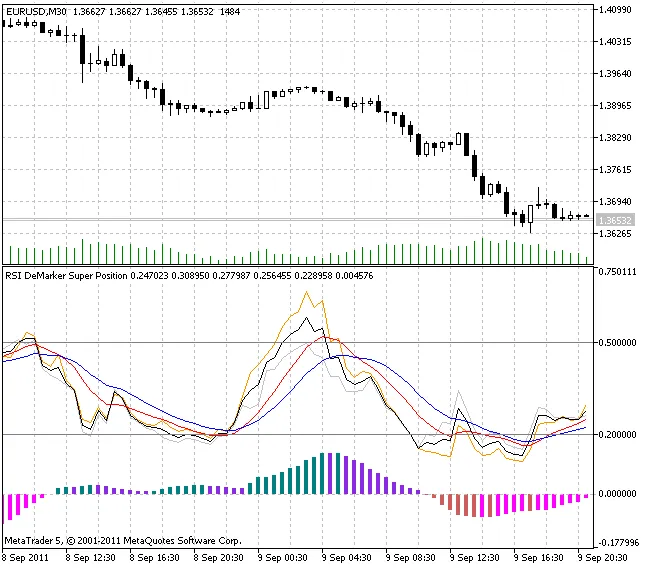
Author: Cronex The RSI and DeMarker indicators are vital tools for any trader. However, constantly switching between periods and parameters can be a real hassle when you’re trying to analyze market trends. Enter the Cronex Super Position indicator. This powerful tool is designed to streamline your analysis by bringing together the insights from both the RSI and DeMarker indicators in one cohesive view. The Cronex Super Position does several things: It calculates four different RSI lines based on varying periods (the period settings can be adjusted in the indicator's parameters) to create a weighted average. Similarly, it computes four DeMarker lines that also vary in periods, leading to another weighted average. The results from both averages are unified for easy interpretation, taking into account the differences between RSI and DeMarker. This unique superposition of the two indicators is based on their weighted averages, providing a clearer picture of market dynamics. For better analysis, two moving averages (MAs) are displayed on the superposition line. The histogram visualizes the difference between the weighted averages of RSI and DeMarker, giving you a complete overview of the situation. In essence, this indicator combines characteristics of different periods and dynamics. It’s common knowledge that RSI and DeMarker can behave quite differently during uncertain market conditions and in relation to their various periods. Thus, having a tool to visualize these differences can be incredibly insightful. The Cronex Super Position indicator utilizes the СMoving_Average class from the SmoothAlgorithms.mqh library. You can find more details about this class in the article "Averaging Price Series for Intermediate Calculations Without Using Additional Buffers". Originally, this indicator was implemented in MQL4 and posted on CodeBase back on January 14, 2008.

2011.10.29
Understanding the RAVI Indicator for MetaTrader 5: A Trader's Guide
MetaTrader5
Understanding the RAVI Indicator for MetaTrader 5: A Trader's Guide

Hey fellow traders! Today, I want to dive into a handy tool for your trading arsenal—the RAVI (Range Action Verification Index) indicator, developed by T. Chande. This indicator offers a unique perspective compared to traditional indicators like the ADX. At its core, RAVI uses a 13-week Simple Moving Average (SMA) to gauge the mood of market participants over a quarter (that's about three months or 65 trading days). To keep things simple, the short average is roughly 10% of the long one, which averages out to about 7 days. The RAVI formula looks like this: RAVI = 100*(SMA(7) - SMA(65)) / SMA(65) Here, SMA(period) refers to the simple moving average calculated over the specified period. Chande recommends using reference lines at plus-minus 0.3% or plus-minus 0.1%, depending on the market conditions. When the RAVI line crosses the reference line upwards, it signals the start of a new uptrend. Conversely, a downward crossover indicates a potential downtrend. If the RAVI line is on the rise, expect the trend to keep pushing up. If it’s falling, brace yourself for a possible downturn. A reversal of the RAVI indicator back to the zero line suggests that the current trend is over and we might be entering a channel. However, if the indicator flips back without breaching the reference lines, it usually means the trend is resuming. The RAVI indicator is straightforward and bears resemblance to other indicators like the MACD and Price Oscillator. What's unique about RAVI is its focus on movement convergence-divergence, making it an effective trend indicator that considers divergence rather than just crossing averages. Unlike the ADX, which utilizes two smoothings, RAVI only has one. This means it's more sensitive and can provide earlier signals regarding the start or end of a trend compared to an 18-day ADX. This indicator lets you pick from ten different smoothing types: SMA - simple moving average; EMA - exponential moving average; SMMA - smoothed moving average; LWMA - linear weighted moving average; JJMA - JMA adaptive average; JurX - ultralinear smoothing; ParMA - parabolic smoothing; T3 - Tillson's multiple exponential smoothing; VIDYA - smoothing using Tushar Chande's algorithm; AMA - smoothing based on Perry Kaufman's algorithm. Keep in mind that the phase type parameters vary significantly between different smoothing algorithms. For instance, in JMA, the phase variable ranges from -100 to +100, while for T3, it's a smoothing ratio multiplied by 100 for better visibility. For VIDYA, it's related to the CMO oscillator period, and for AMA, it’s the slow EMA period. Other algorithms might not have any effect on smoothing from these parameters. Importantly, the fast EMA period for AMA is fixed at 2 by default. To use this indicator, make sure to include the SmoothAlgorithms.mqh library classes in your terminal_data_folder\MQL5\Include. You can find a detailed explanation of these classes in the article "Averaging Price Series for Intermediate Calculations Without Using Additional Buffers". Originally, this indicator was implemented in MQL4 and published in CodeBase on February 15, 2008.

2011.10.29

Unlocking the XVSI Indicator for MetaTrader 5: A Trader's Guide
MetaTrader5
Unlocking the XVSI Indicator for MetaTrader 5: A Trader's Guide

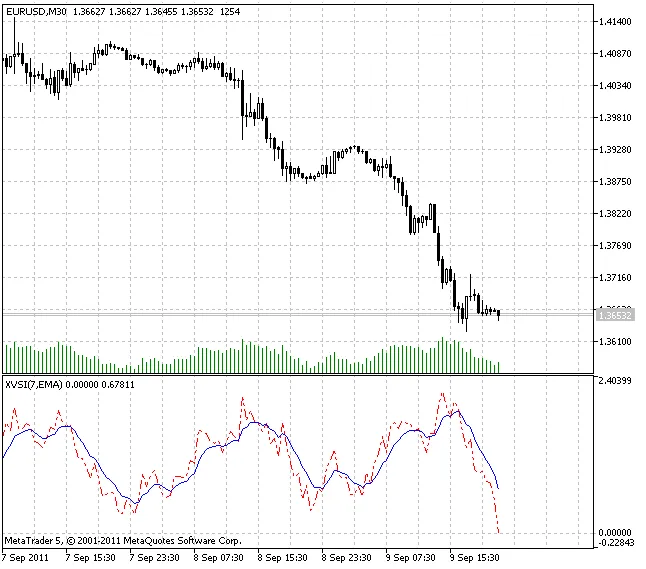
Author: DriverDan The XVSI indicator is a powerful tool designed for MetaTrader 5 that calculates volume based on the moving average over a specified period. It’s a great addition to any trader’s toolkit, especially when you want to fine-tune your trading strategy. This indicator offers the flexibility to choose from ten different smoothing types: SMA - Simple Moving Average EMA - Exponential Moving Average SMMA - Smoothed Moving Average LWMA - Linear Weighted Moving Average JJMA - JMA Adaptive Average JurX - Ultralinear Smoothing ParMA - Parabolic Smoothing T3 - Tillson's Multiple Exponential Smoothing VIDYA - Smoothing with Tushar Chande's Algorithm AMA - Smoothing with Perry Kaufman's Algorithm Keep in mind that the parameters for different smoothing algorithms can vary significantly. For instance, with the JMA, the Phase variable ranges from -100 to +100. For the T3 method, the smoothing ratio is multiplied by 100 for clearer visualization. VIDYA utilizes a CMO oscillator period, while the AMA employs a slow EMA period. In some algorithms, these parameters won’t affect smoothing at all, but for AMA, the fast EMA period is set to a default of 2. The XVSI indicator leverages the SmoothAlgorithms.mqh library classes, which you’ll need to copy to your terminal_data_folder/MQL5/Include. There’s a detailed explanation of how to use these classes in the article "Averaging Price Series for Intermediate Calculations Without Using Additional Buffers". This indicator originally made its debut in MQL4 and was published in CodeBase on September 19, 2007.

2011.10.28
Understanding the Mass Index Indicator for MetaTrader 5
MetaTrader5
Understanding the Mass Index Indicator for MetaTrader 5

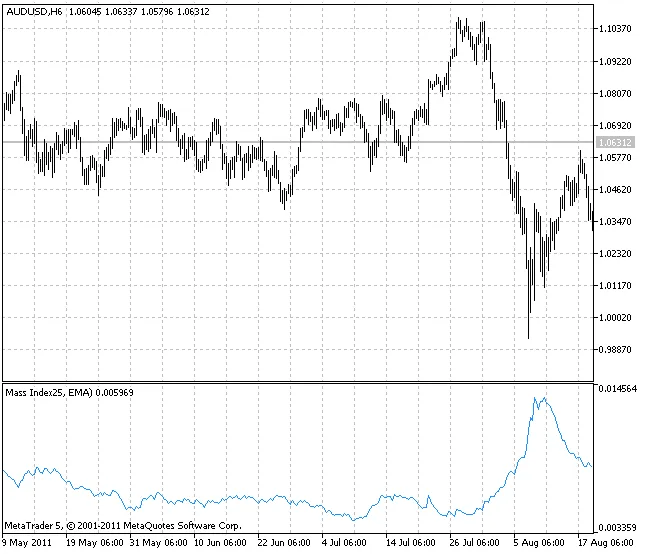
The Mass Index, brought into the spotlight by Tushar Chande and Donald Dorsey, is a handy tool for traders looking to spot potential trend reversals. This indicator works by summing the exponentially smoothed moving averages of high-low day ranges over the last 25 periods. Essentially, it measures how the average range between the highest and lowest prices is changing. When that range starts to widen, you'll see the Mass Index climb, and when it narrows, the index will drop. To generate buy or sell signals, the Mass Index employs an exponential moving average, typically set to a period of 9. If the Mass Index indicates a potential reversal and the moving average shows a downtrend, it's a cue to open a long position. Conversely, if the moving average points to an uptrend, it might be time to go short. One of the great things about the Mass Index is its flexibility. You can choose from ten different smoothing types: SMA - Simple Moving Average; EMA - Exponential Moving Average; SMMA - Smoothed Moving Average; LWMA - Linear Weighted Moving Average; JJMA - JMA Adaptive Average; JurX - Ultralinear Smoothing; ParMA - Parabolic Smoothing; T3 - Tillson's Multiple Exponential Smoothing; VIDYA - Smoothing using Tushar Chande's algorithm; AMA - Smoothing using Perry Kaufman's algorithm. It's important to know that the phase-type parameters for different smoothing algorithms carry distinct meanings. For example, in JMA, it ranges from -100 to +100, while T3 uses a smoothing ratio multiplied by 100 for clarity. VIDYA employs a CMO oscillator period, and for AMA, the slow EMA period is crucial. In other algorithms, these parameters typically don’t affect the smoothing. For AMA, the fast EMA period is preset at 2, and the raising power ratio is also set to 2. To get started with the Mass Index, you’ll need to have the SmoothAlgorithms.mqh library classes available in your terminal_data_folder/MQL5/Include. For a deep dive into using these classes, check out the article "Averaging Price Series for Intermediate Calculations Without Using Additional Buffers".

2011.10.28
Understanding the Klinger Volume Oscillator (KVO) for MetaTrader 5
MetaTrader5
Understanding the Klinger Volume Oscillator (KVO) for MetaTrader 5

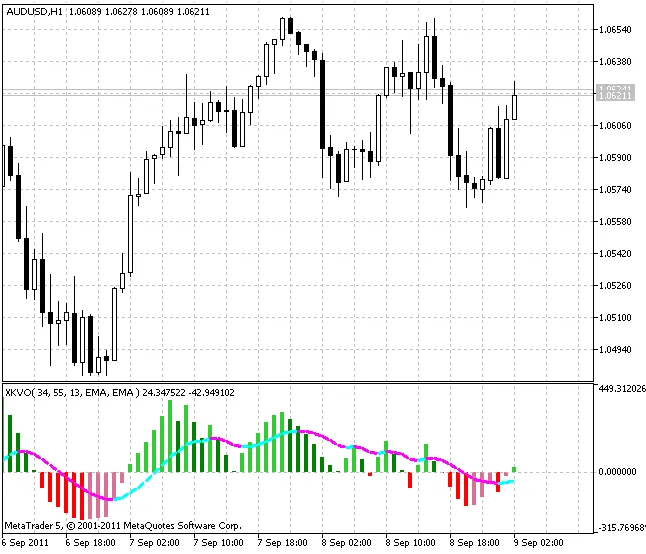
The Klinger Volume Oscillator (KVO) was created by Stephen Klinger and has become a staple for many traders. What makes the KVO unique is that it balances short-term signals of market tops and bottoms with a robust indication of long-term money flow. This dual functionality allows traders to gain insights into both immediate and sustained market trends. Here’s how the KVO operates: Price range indicates movement while volume reflects the strength of that movement. By adding High, Low, and Close prices, you can identify a trend. If today's total exceeds yesterday's, it suggests accumulation; if it's less, there’s distribution. If the totals are equal, the current trend remains unchanged. Volume fluctuations impact intraday prices, showcasing buyer and seller strength. The KVO measures this strength by calculating the difference between accumulated and distributed shares daily. A high and rising volume indicates an impending bullish trend, while a gradual decline in volume often precedes the end of a bullish trend and the start of a bearish one. A resurgence in volume strength signals potential accumulation before a market bottom forms. Once the volume strength is transformed into an oscillator, representing the difference between the 34-day and 55-day exponential moving averages with a 13-day signal line, it becomes easier to track market entry and exit points. Comparing this volume strength with price movements can help you spot divergences between tops and bottoms. Klinger emphasizes these key concepts when using the KVO: The most reliable signals align with the prevailing trend; The strongest signal is a divergence between new price highs/lows and the indicator, particularly in overbought/oversold zones; In a bullish trend, look to buy when the KVO drops to significantly low levels (below zero) and then turns upward, crossing its signal line. Conversely, during a bearish trend, consider selling when the KVO rises to high levels (above zero) and then turns down, crossing its signal line. It’s essential to remember that the KVO performs best when trading in the direction of the trend. It tends to be less effective when going against it. This indicator allows you to choose from ten distinct options for smoothing the histogram and the KVO signal line: SMA - Simple Moving Average; EMA - Exponential Moving Average; SMMA - Smoothed Moving Average; LWMA - Linear Weighted Moving Average; JJMA - JMA Adaptive Moving Average; JurX - Ultra Linear Smoothing; ParMA - Parabolic Smoothing; T3 - Tillson's Multiple Exponential Smoothing; VIDYA - Tushar Chande's Algorithm Smoothing; AMA - Perry Kaufman's Algorithm Smoothing. It's important to note that the parameters Phase1 and Phase2 vary significantly across different smoothing algorithms. For JMA, Phase is an external variable ranging from -100 to +100. For T3, it’s a smoothing ratio multiplied by 100 for better visualization. For VIDYA, it represents the oscillator CMO period, while for AMA, it refers to the slow EMA period. These parameters don't influence smoothing calculations in other algorithms. In AMA, the fast EMA period defaults to a fixed value of 2, and the growth factor for AMA is also set to 2. This indicator utilizes the SmoothAlgorithms.mqh class library (which should be copied to terminal_data_folder\MQL5\Include). More details on using this class are outlined in the article "Average Price Series for Intermediate Calculations without Extra Buffers".

2011.10.28
Unlocking Trading Potential with the BB XMACD Indicator for MetaTrader 5
MetaTrader5
Unlocking Trading Potential with the BB XMACD Indicator for MetaTrader 5

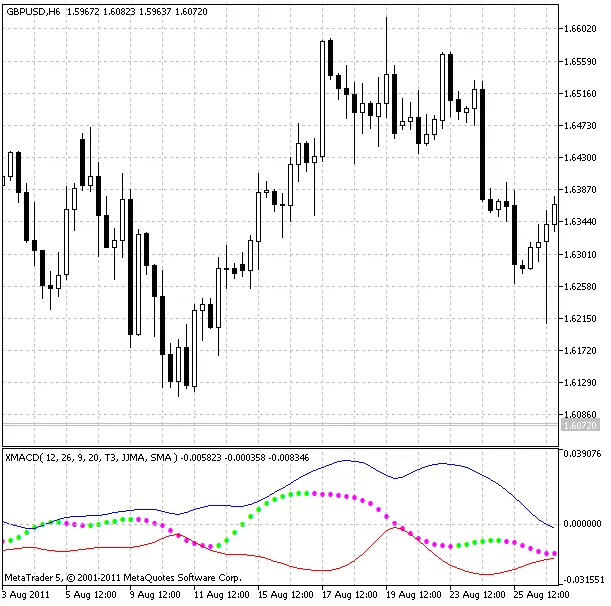
Hey there, fellow traders! Today, let’s dive into the BB XMACD, an innovative twist on the classic MACD (Moving Average Convergence/Divergence) indicator that can help pinpoint trend changes and measure trend strength effectively. This indicator operates in a separate chart window and features two prominent lines (one blue and one red) along with dots that can appear in either green or magenta. Keep an eye on those dot colors—when they change, it’s often a strong signal! Plus, the distance between the two lines gives you a good indication of the current trend's strength. For instance, take a look at the sample chart. When you notice magenta dots turning green, it's a signal to buy. Conversely, if the dots flip back to magenta, it’s time to consider selling. Ideally, you want to make trades when there’s a significant gap between the blue and red lines, as this often indicates a stronger trend. One of the cool features of the BB XMACD is that it allows you to customize the smoothing type for the MACD histogram, signal line, and bands. You’ve got ten different options to choose from: SMA - Simple Moving Average; EMA - Exponential Moving Average; SMMA - Smoothed Moving Average; LWMA - Linear Weighted Moving Average; JJMA - JMA Adaptive Average; JurX - Ultralinear Smoothing; ParMA - Parabolic Smoothing; T3 - Tillson's Multiple Exponential Smoothing; VIDYA - Smoothing using Tushar Chande's Algorithm; AMA - Smoothing using Perry Kaufman's Algorithm. It's worth mentioning that the Phase type parameters for different smoothing algorithms can vary significantly. For example, with JMA, the Phase variable ranges from -100 to +100. For T3, it represents a smoothing ratio multiplied by 100 for better clarity. Meanwhile, VIDYA uses a CMO oscillator period and AMA is based on a slow EMA period. Keep in mind that in some algorithms, these parameters don’t influence the smoothing process. For AMA, the fast EMA period defaults to a fixed value of 2, as does the power ratio. To get the most out of this indicator, ensure you have the SmoothAlgorithms.mqh library classes copied to your terminal_data_folder/MQL5/Include. You can find more details about how to use these classes in the article "Averaging Price Series for Intermediate Calculations Without Using Additional Buffers".

2011.10.28
Unlocking the Power of the XMACD Indicator for MetaTrader 5
MetaTrader5
Unlocking the Power of the XMACD Indicator for MetaTrader 5

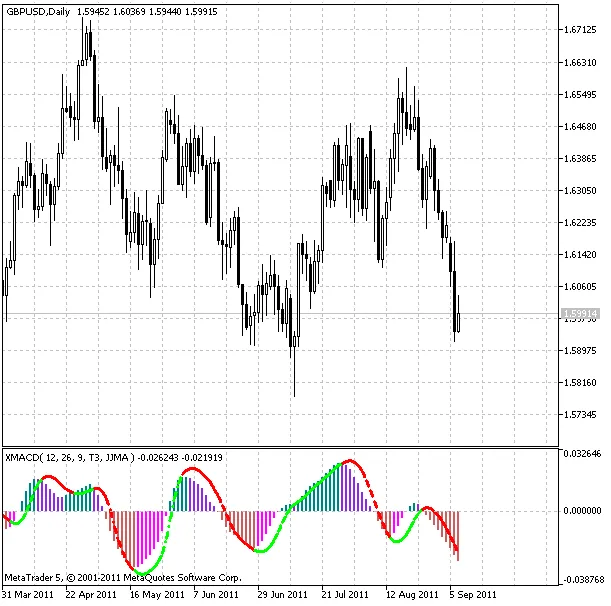
Hey fellow traders! Today, we're diving into the XMACD indicator for MetaTrader 5. This nifty tool is an upgraded version of the classic MACD, giving you flexibility with histogram and signal line smoothing algorithms. You’ve got a choice of ten different smoothing options, so let’s break them down: SMA - Simple Moving Average; EMA - Exponential Moving Average; SMMA - Smoothed Moving Average; LWMA - Linear Weighted Moving Average; JJMA - JMA Adaptive Average; JurX - Ultralinear Smoothing; ParMA - Parabolic Smoothing; T3 - Tillson's Multiple Exponential Smoothing; VIDYA - Smoothing with Tushar Chande's Algorithm; AMA - Smoothing with Perry Kaufman's Algorithm. A little heads-up—the Phase1 and Phase2 parameters can mean different things depending on the smoothing algorithm you choose. For instance, with JMA, the Phase variable ranges from -100 to +100. In contrast, for T3, it’s a smoothing ratio times 100, while VIDYA uses a CMO oscillator period and AMA works with a slow EMA period. So, make sure you're clear on how these parameters affect your chosen algorithm. For AMA, the fast EMA is fixed at 2, and the power ratio is also set to 2. Another cool feature of this indicator is that the histogram and signal line colors change based on market conditions. Plus, the ColorXMACD_Alert indicator can notify you if the signal line color shifts on the latest closed bar. Just remember to copy the SmoothAlgorithms.mqh library classes to your terminal_data_folder\MQL5\Include directory for it to work seamlessly. You can find a detailed explanation of these classes in the article "Averaging Price Series for Intermediate Calculations Without Using Additional Buffers". This indicator was initially created in MQL4 and discussed in an earlier article titled "Effective Averaging Algorithms with Minimal Lag: Use in Indicators and Expert Advisors" back on March 3, 2009.

2011.10.28
Mastering the XRVI Indicator for MetaTrader 5: A Trader's Guide
MetaTrader5
Mastering the XRVI Indicator for MetaTrader 5: A Trader's Guide

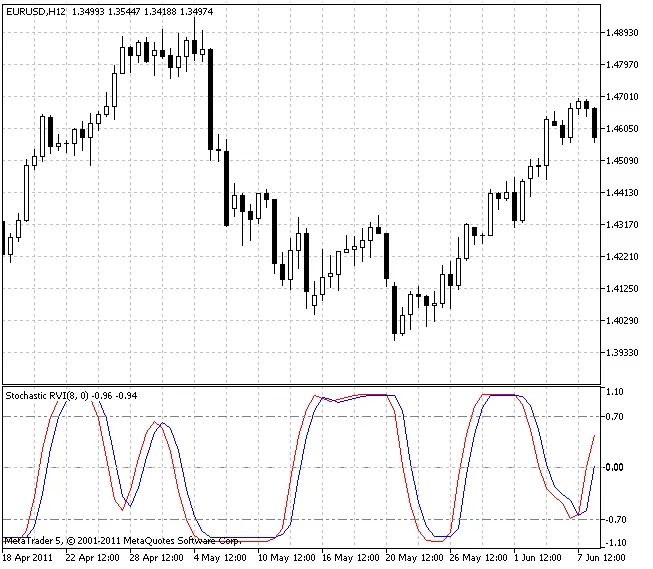
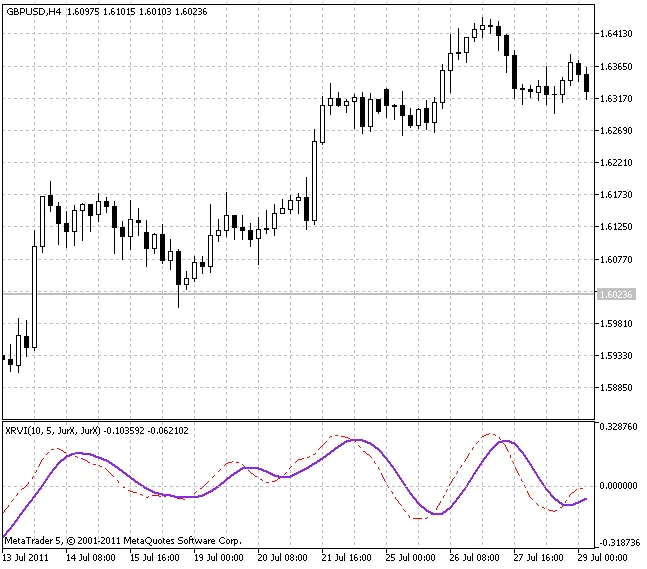
Relative Vigor Index (RVI) is an insightful tool for traders, based on the principle that closing prices tend to be higher than opening prices during an uptrend. Conversely, in a downtrend, the opposite holds true. The RVI essentially normalizes price changes by dividing the difference between the closing and opening prices by the maximum price range within a single bar, represented by the formula: RVI = (CLOSE - OPEN) / (HIGH - LOW) where: OPEN - the opening price; HIGH - the highest price; LOW - the lowest price; CLOSE - the closing price. To smooth out erratic price movements, the oscillator applies a smoothing technique. The signal line is derived in the same manner. What sets this version of RVI apart is the flexibility it offers; you can tweak both the RVI and the signal line's smoothing algorithms, choosing from ten different methods: SMA - Simple Moving Average; EMA - Exponential Moving Average; SMMA - Smoothed Moving Average; LWMA - Linear Weighted Moving Average; JJMA - JMA Adaptive Average; JurX - Ultralinear Smoothing; ParMA - Parabolic Smoothing; T3 - Tillson's Multiple Exponential Smoothing; VIDYA - Smoothing with Tushar Chande's Algorithm; AMA - Smoothing with Perry Kaufman's Algorithm. It's important to note that the Phase parameter varies significantly with different smoothing algorithms: For JMA, it's an external Phase variable ranging from -100 to +100. For T3, it's a smoothing ratio multiplied by 100 for clearer visualization; For VIDYA, it corresponds to the CMO period; for AMA, it indicates the slow EMA period; In the case of AMA, the fast EMA period is fixed at a value of 2 by default, and the raising power ratio is also set to 2. The indicator employs the SmoothAlgorithms.mqh library classes, which must be copied into the terminal_data_folder\MQL5\Include. For an in-depth look at how to utilize these classes, check out the article "Averaging Price Series for Intermediate Calculations Without Using Additional Buffers".

2011.10.26
First Previous 316 317 318 319 320 321 322 323 324 325 326 Next Last