
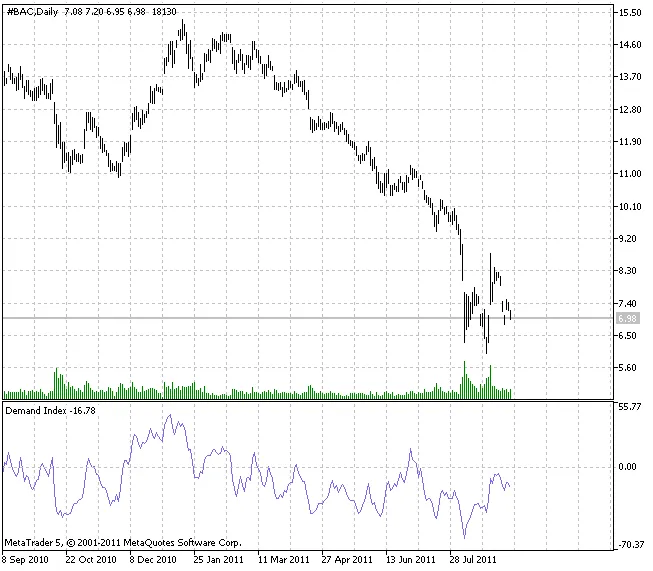
The Demand Index, crafted by James Sibbet, is a powerful tool for traders looking to analyze price and volume dynamics. This leading indicator ranges from +100 to -100, providing insights into market strength and potential reversals. It’s essential to grasp how this index operates to enhance your trading strategy.
Here are six key rules to keep in mind when using the Demand Index:
- Divergence between the Index and price trends often indicates a weak price movement.
- When market activity ramps up, new price highs typically follow peaks in the Demand Index—acting as a forward-looking guide.
- If prices hit new highs while the Index dips below its previous peak, be wary of significant reversals—here, the Index serves as a confirming indicator.
- When the Index crosses the zero line, it signals a shift in trend—this is where the Index acts as a lagging indicator.
- If the Index hovers around the zero level for an extended period, it suggests that the current price move is weak and unlikely to sustain.
- Long-term divergence between price and Index values often points towards major tops and bottoms in the market.
The Demand Index also offers flexibility in smoothing options, allowing you to choose from ten different methods:
- SMA - Simple Moving Average
- EMA - Exponential Moving Average
- SMMA - Smoothed Moving Average
- LWMA - Linear Weighted Moving Average
- JJMA - JMA Adaptive Average
- JurX - Ultralinear Smoothing
- ParMA - Parabolic Smoothing
- T3 - Tillson's Multiple Exponential Smoothing
- VIDYA - Smoothing using Tushar Chande's Algorithm
- AMA - Smoothing using Perry Kaufman's Algorithm
It’s worth noting that each smoothing method has its own unique parameters. For instance, the Phase type for JMA ranges from -100 to +100, while for T3, it’s a smoothing ratio for better visualization. The parameters for VIDYA represent a CMO oscillator period, and for AMA, it's a slow EMA period with a default value of 2. Keep in mind that in other algorithms, these parameters might not influence the smoothing process.
The Demand Index utilizes the SmoothAlgorithms.mqh library classes, which can be found in the terminal_data_folder/MQL5/Include. For a deeper dive into these classes, check out the article titled "Averaging Price Series for Intermediate Calculations Without Using Additional Buffers".
Related Posts
- Unlocking MetaCOT 2: Your Ultimate CFTC Indicator Toolkit for MT4
- Visualize Current Trends Across All Time Frames with This MetaTrader 4 Indicator
- Unlocking the Power of Master Tools for MetaTrader 4
- Mastering the Waddah Attar Trend Alert Indicator for MetaTrader 5
- Unlocking the Power of ColorJFatl_Digit_Alert: Your Go-To MT5 Indicator