
Money Flow Index (MFI) is a vital technical indicator that helps traders gauge the rate at which money flows into and out of a security.
Its construction and interpretation are quite similar to the Relative Strength Index (RSI), but with a key difference: volume plays a crucial role in the MFI calculations.
When you're digging into the Money Flow Index, keep the following points in mind:
- Divergences between the MFI and price trends can signal a reversal. For instance, if prices are climbing while the MFI is declining (or the other way around), it’s a strong indicator that a price shift might be on the horizon.
- Values above 80 suggest a potential market peak, while those below 20 indicate a possible bottom.
Image:
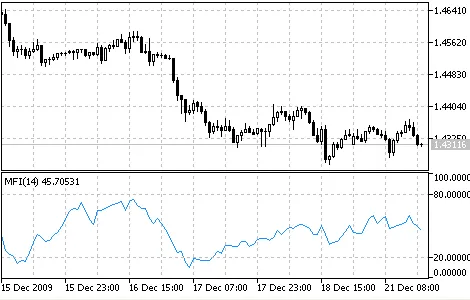
Money Flow Index indicator
How is MFI Calculated?
The calculation of the Money Flow Index involves several steps:
TP = (HIGH + LOW + CLOSE) / 3
First, you'll determine the typical price (TP) for the period in question. Next, calculate the Money Flow (MF):
MF = TP * VOLUME
If today’s typical price exceeds yesterday’s TP, we consider the money flow positive. Conversely, if it’s lower, the money flow is negative.
Positive Money Flow is the total of positive money flows over a selected period, while Negative Money Flow is the sum of negative flows over that same period.
Next up, we calculate the money ratio (MR) by dividing positive money flow by negative money flow:
MR = POSITIVE MONEY FLOW / NEGATIVE MONEY FLOW
Finally, we can compute the Money Flow Index using the money ratio:
MFI = 100 - (100 / (1 + MR))
Here’s what each term means:
- HIGH: The highest price of the current bar;
- LOW: The lowest price of the current bar;
- CLOSE: The closing price of the current bar;
- VOLUME: The volume of the current bar.




Comments 0