
The Money Flow Index (MFI) is a powerful tool that helps traders gauge the pace at which money is flowing into and out of a security. Think of it as a pulse check on market sentiment!
Much like the Relative Strength Index (RSI), the MFI provides insights into price momentum, but with a key twist: it also factors in trading volume, making it a handy indicator for those looking to capitalize on market movements.
When diving into the MFI, here are a few critical points to keep in mind:
Divergences: Watch for discrepancies between the MFI and price action. If prices are climbing while the MFI is dropping (or the other way around), it could signal an impending price reversal.
Threshold Levels: An MFI reading above 80 or below 20 can indicate that a security is potentially reaching a market peak or bottom, respectively. These levels can be goldmines for savvy traders!
How to Calculate the MFI
Calculating the MFI involves several steps, starting with determining the typical price (TP) for the period you're analyzing:
TP = (HIGH + LOW + CLOSE) / 3
Next, you'll want to calculate the Money Flow (MF):
MF = TP * VOLUME
If today's typical price is higher than yesterday’s, you’ve got a positive money flow. Conversely, if it’s lower, that’s negative money flow. Sum up the positive flows for your chosen timeframe to get the total positive money flow, and do the same for negative flows.
Now, let’s find the money ratio (MR) by dividing the positive money flow by the negative money flow:
MR = Positive Money Flow (PMF) / Negative Money Flow (NMF)
Finally, plug your money ratio into this formula to get the MFI:
MFI = 100 - (100 / (1 + MR))
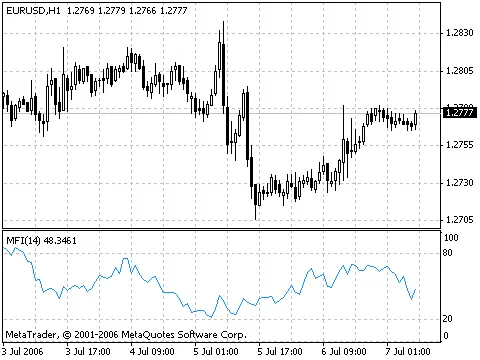
If you’re hungry for more detailed insights on the MFI, check out the Technical Analysis: Money Flow Index on MetaTrader.




Comments 0