
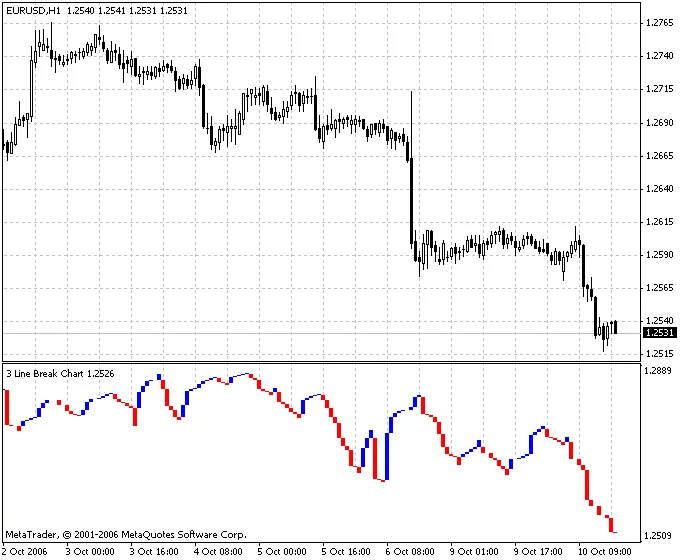
Three-line break charts are an interesting tool in the trader's toolkit, offering a unique perspective on price movements. Unlike traditional charts, which factor in time, these charts present a straightforward visualization of price changes through vertical rectangles. The height of each rectangle corresponds to the magnitude of price fluctuations. This method of charting is similar to Kagi, Point & Figure (P&F), and Renko charts, focusing solely on price action.
Originally popularized in the United States by Steven Nison in his book Beyond Candlesticks, three-line break charts have become a staple for many traders. Let's dive into the basics of how to trade using this method:
- Buy Signal: When you spot three consecutive red lines followed by a blue line (the 'blue reversal line'), it's time to consider buying.
- Sell Signal: Conversely, if you see three blue lines followed by a red line (the 'red reversal line'), that’s your cue to sell.
- No Trading Zone: Avoid trading when the lines alternate between blue and red without forming a stable trend.
One of the significant advantages of three-line break charts is that the reversal criteria are not arbitrarily set. Instead, they are dictated by price dynamics. However, a downside is that reversal signals may appear only after a new trend has already formed, meaning some traders might miss the initial move. That said, many traders are willing to wait for a more reliable confirmation to capitalize on larger trends.
For those looking to adjust their trading approach, the sensitivity of reversal signals can be modified by changing the number of lines used to indicate a break. Short-term traders might prefer a two-line break for more frequent signals, while long-term investors might opt for four or even ten-line breaks to reduce signal noise. In Japan, the three-line break method is particularly popular among traders.
As recommended by S. Nison, combining three-line break charts with candlestick analysis can enhance your trading strategy. By using three-line breaks to identify the primary trend direction, you can pinpoint optimal entry and exit points for your trades.
Parameters:
LB - count of break lines




Comments 0