
The Variable Index Dynamic Average (VIDYA) is a unique technical indicator crafted by Tushar Chande that every trader should have on their radar.
Unlike the standard Exponential Moving Average (EMA), VIDYA features a dynamically changing averaging period based on market volatility. This volatility is gauged using the Chande Momentum Oscillator (CMO).
The CMO measures the ratio of positive price changes to negative price changes over a specified period. This value is then utilized as the smoothing factor for the EMA, which means you'll need to set parameters for both the CMO and EMA periods when using VIDYA.
How to Use VIDYA
Typically, traders don't solely rely on VIDYA itself but rather on its upper and lower bands, which are set N% above and below the VIDYA line. This interpretation is akin to how you’d analyze Bollinger Bands® for trade signals.
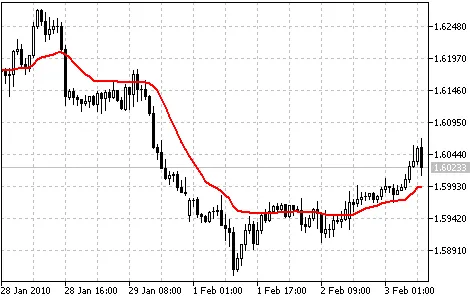
Variable Index Dynamic Average Indicator
How is VIDYA Calculated?
The standard Exponential Moving Average is calculated using the following formula:
Where:
- F: Smoothing factor = 2 / (Period_EMA + 1);
- Period_EMA: The length of the EMA period;
- Price(i): Current price;
- EMA(i-1): Previous EMA value.
The VIDYA value is then calculated similarly using the CMO:
Where:
- ABS(CMO(i)): Absolute value of the current Chande Momentum Oscillator;
- VIDYA(i-1): Previous VIDYA value.
Finally, the CMO itself is calculated using this formula:
Here:
- UpSum(i): Current sum of positive price changes over the period;
- DnSum(i): Current sum of negative price changes over the period.
Related Posts
- Unlocking MetaCOT 2: Your Ultimate CFTC Indicator Toolkit for MT4
- Mastering the MACD Candle Indicator for MetaTrader 4
- Hourly Buffers for Data Collection in MetaTrader 5: A Simple Guide
- Visualize Current Trends Across All Time Frames with This MetaTrader 4 Indicator
- Unlocking the Power of Master Tools for MetaTrader 4