
Hey there, fellow traders! If you’ve been in the game for a while, you know that price movements can be a bit like waves—constantly rising and falling. These fluctuations are driven by shifts in investor sentiment and the ongoing battle between bulls and bears in the market.
The Price Rate of Change (ROC) indicator acts like an oscillator, capturing this ebb and flow by measuring the price changes over a specific period. When prices rise, the ROC rises; when they fall, so does the ROC. The more significant the price movement, the more pronounced the changes in the ROC.
The 12-day and 25-day ROC indicators are particularly popular among traders. The 12-day ROC is a fantastic tool for identifying overbought or oversold conditions in both short-term and medium-term trading scenarios.
As a rule of thumb, a higher ROC suggests a stronger likelihood of a price increase. However, as with any overbought or oversold indicators, it’s wise to hold off on jumping into a trade until the market shows a clear direction—either turning up or down. Just because the market looks overbought doesn’t mean it’ll reverse immediately; trends can persist longer than you might expect.
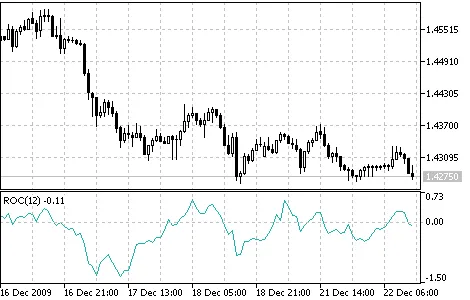
Price Rate of Change indicator
How to Calculate ROC:
To find the speed of price change, you simply take the difference between the current closing price and the closing price from 'n' periods ago.
ROC = ((CLOSE (i) - CLOSE (i - n)) / CLOSE (i - n)) * 100
Where:
- CLOSE (i) - the closing price of the current bar;
- CLOSE (i - n) - the closing price 'n' bars ago;
- ROC - the value of the Price Rate of Change indicator.



Comments 0