
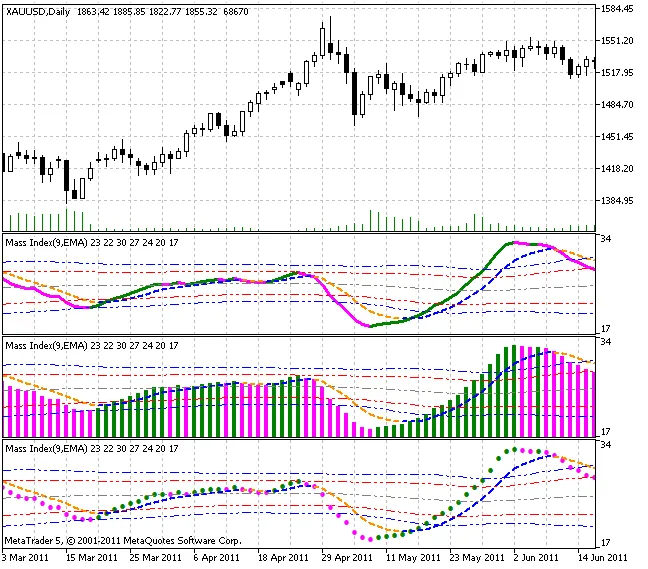
The Mass Index (MI) is a nifty tool for traders looking to spot potential trend reversals by examining the bandwidth between the highest and lowest prices.
When the bandwidth expands, the Mass Index rises; conversely, it falls when the bandwidth narrows. This indicator gained traction thanks to the work of Tushar Chande and Donald Dorsey.
One of the key signals to watch for, according to Dorsey, is a specific pattern known as the 'reversal bulge'. This pattern appears when the 25-period Mass Index first exceeds 27 and then dips below 26.5. When this happens, brace yourself for a possible price turn, regardless of the current trend direction—whether prices are climbing, dropping, or bouncing around in a range.
To determine whether the signal from the reversal bulge suggests a buy or sell, many traders turn to a 9-period exponential moving average (EMA) of prices. If the reversal bulge forms while the moving average is declining, it's time to buy; if it's on the rise, consider selling.
How to Calculate the Mass Index:
MI = SUM (EMA (HIGH - LOW, 9) / EMA (EMA (HIGH - LOW, 9), 9), N)
In this formula:
- SUM - the sum of values;
- HIGH - the highest price of the current bar;
- LOW - the lowest price of the current bar;
- EMA - exponential moving average;
- N - the period for the indicator (the number of values to sum).
You’re not limited to using EMA smoothing with the Mass Index. You can switch up the smoothing algorithm among ten different options:
- SMA - simple moving average;
- EMA - exponential moving average;
- SMMA - smoothed moving average;
- LWMA - linear weighted moving average;
- JJMA - JMA adaptive average;
- JurX - ultralinear smoothing;
- ParMA - parabolic smoothing;
- T3 - Tillson's multiple exponential smoothing;
- VIDYA - Tushar Chande's smoothing algorithm;
- AMA - Perry Kaufman's smoothing algorithm.
Keep in mind that the phase parameters for different smoothing algorithms can have significantly different meanings. For example, for JMA, it’s an external phase variable ranging from -100 to +100. For T3, it’s a smoothing ratio multiplied by 100 for better visualization. VIDYA uses a CMO oscillator period, while AMA relies on a slow EMA period. In some algorithms, these parameters don’t influence smoothing. For AMA, the fast EMA period is set at a default value of 2, and the power ratio is also 2.
The indicator utilizes classes from the SmoothAlgorithms.mqh library (make sure to copy this to your terminal_data_folder\MQL5\Include). You can find a detailed explanation of this in the article "Averaging Price Series for Intermediate Calculations Without Using Additional Buffers".
Originally, this indicator was implemented in MQL4 and published in the Code Base on 08.02.2007.
Related Posts
- Unlocking MetaCOT 2: Your Ultimate CFTC Indicator Toolkit for MT4
- Visualize Current Trends Across All Time Frames with This MetaTrader 4 Indicator
- Mastering the MACD Candle Indicator for MetaTrader 4
- Hourly Buffers for Data Collection in MetaTrader 5: A Simple Guide
- Unlocking the Power of Master Tools for MetaTrader 4