
The DeMarker indicator (DeM) is a powerful technical tool that traders use to gauge market conditions. It works by comparing the highest price of the current period with that of the previous period.
Here’s the gist: if the current period's maximum price is higher than the last, we note the difference. If it’s lower or the same, we record a zero. Over a set number of periods, these differences are totaled up. This total becomes the numerator in our DeMarker calculation, which is then divided by the same total plus the differences between the highest prices of the current and previous periods. If the current low is higher than the last low, we again note a zero.
When the DeMarker dips below 30, it could signal a potential bullish reversal. Conversely, if it climbs above 70, you might want to brace for a bearish reversal. Keep these thresholds in mind as you analyze the market!
For those of you looking at longer timeframes, using this indicator can help you identify broader market trends. On the flip side, shorter periods can give you insights into entry points with minimized risk, allowing you to time your trades in line with the prevailing trend.
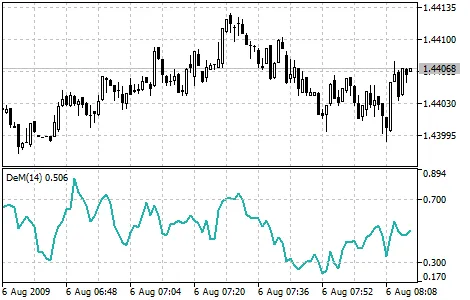
The DeMarker Indicator in Action
How to Calculate the DeMarker Indicator:
To calculate the DeMarker for a specific interval (let's call it 'i'), follow these steps:
First, we determine DeMax (i):
If HIGH (i) > HIGH (i - 1), then: DeMax (i) = HIGH (i) - HIGH (i - 1)
Otherwise, DeMax (i) = 0
Next, we find DeMin (i):
If LOW (i) Otherwise, DeMin (i) = 0
Then, we calculate the DeMarker value like this:
DMark (i) = SMA (DeMax, N) / (SMA (DeMax, N) + SMA (DeMin, N))
Where:
- HIGH (i) - the highest price of the current bar;
- LOW (i) - the lowest price of the current bar;
- HIGH (i - 1) - the highest price of the previous bar;
- LOW (i - 1) - the lowest price of the previous bar;
- SMA - Simple Moving Average;
- N - the number of bars used for the calculation.




Comments 0