
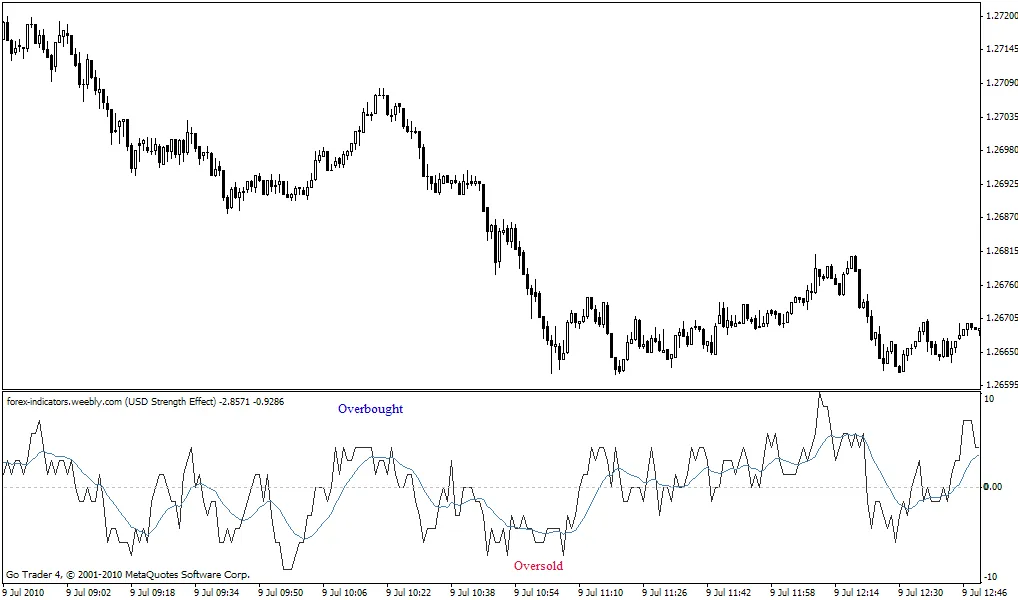
Have you ever wondered how the USD stacks up against other currencies? The USD Strength Effect Indicator for MetaTrader 4 is your go-to tool for gaining insights into the strength of the USD across multiple pairs. It’s highly configurable, allowing you to tailor it to your trading needs.
This indicator evaluates seven currency pairs based on a single base currency, giving you a clear picture of how the currency you're trading is performing. It assigns a value to each pair depending on the movement of two moving averages. If both moving averages are heading in the same direction, the value increases; if they’re moving in opposite directions, you’ll see a reduced value. The indicator operates on a scale from 10 (overbought) to -10 (oversold).
It’s important to understand the difference between major pairs, like USD/CHF, and minor pairs, such as AUD/USD. You can select three major pairs and four minor pairs, all based on the same currency. The default settings are generally spot-on, so you may not need to tweak them much.
For instance, if you prefer to use AUD as your base currency, you can choose three major AUD pairs and four minor AUD pairs. This will help you gauge the overall performance of the AUD, which is especially useful if you're focusing on markets like Tokyo.
The USD Strength Indicator works wonders as a confirming signal alongside other indicators, like the Williams Percent Range, and often proves to be quite predictive.
If you're looking to add an extra layer of confirmation within an Expert Advisor, you can use the following line of code:
double val=iCustom(NULL, 0, "Brooky_USD_Strength", ".", ".", "USDCHF", "USDJPY", "USDCAD", ".", "AUDUSD", "EURUSD", "GBPUSD", "NZDUSD", ".", 55, 34, ".", 15, ".", 0, 1, 0);
Feel free to adjust the 55 and 34 at the end to reflect the slow and fast Moving Averages you prefer for your strength calculations.
Remember, if val >= 8, it indicates that the currency is overbought, while val <= -8 suggests it’s oversold.
Related Posts
- Unlocking MetaCOT 2: Your Ultimate CFTC Indicator Toolkit for MT4
- Hourly Buffers for Data Collection in MetaTrader 5: A Simple Guide
- Unlocking the Power of Master Tools for MetaTrader 4
- Mastering the Open Range Breakout Indicator for MetaTrader 5
- How to Use the Change Chart Symbol Menu for MetaTrader 4