
The Stochastic Rate of Change (ROC) indicator is a powerful tool for traders using MetaTrader 5. It combines the principles of the stochastic oscillator with the rate of change, giving you a unique perspective on market momentum.
Here’s a breakdown of the eight key input parameters you’ll need to set up this indicator:
- Stochastic K Period - This defines the timeframe for calculating the stochastic %K line.
- Stochastic D Period - This sets the timeframe for the stochastic %D line.
- Stochastic Slowing - This parameter controls the smoothing period for the stochastic lines.
- Stochastic MA Method - The method used for calculating the stochastic values.
- Stochastic Price Field - The price type used in the stochastic calculations.
- Stochastic Line - This specifies which stochastic line to use for the indicator calculations:
- Main - The primary line used.
- Signal - The secondary line that acts as a signal.
- ROC Period - The duration for calculating the Rate of Change.
- Calculation Type - This defines how values are calculated:
- Absolute - Using absolute values for calculations.
- Relative - Calculating with relative values.
One great aspect of the ROC indicator is that it doesn’t require additional calculations outside of what it provides. The indicator handles everything behind the scenes.
Here’s how the calculations work:
If Type = Absolute Stochastic, then ROC = ((Stochastic(Now) - Stochastic(Prev)),
If Type = Relative Stochastic, then ROC = ((Stochastic(Now) - Stochastic(Prev)) / Stochastic(Prev)) * 100
For ROC, the formula is:
ROC = ((CLOSE(i) - CLOSE(i - n)) / CLOSE(i - n)) * 100
CLOSE(i) - the closing price of the current bar;
CLOSE(i - n) - the closing price n bars ago;
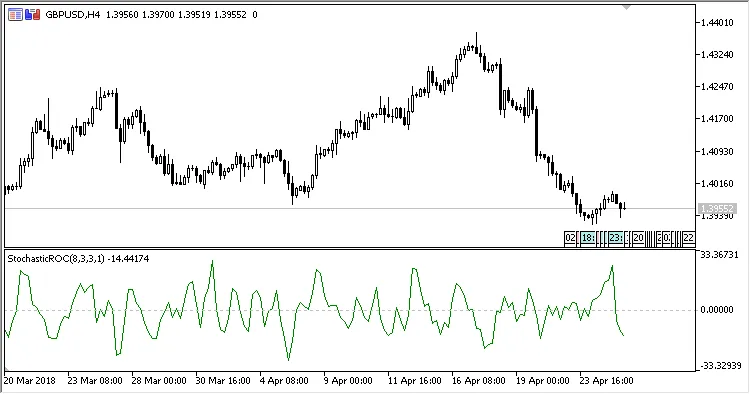
Fig.1. Stochastic ROC Absolute
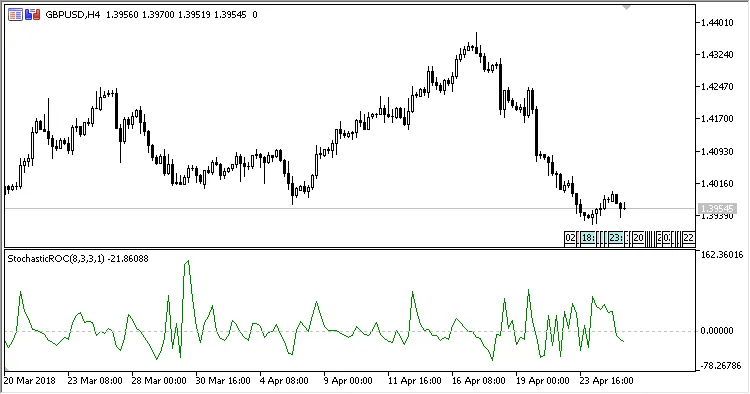
Fig.2. Stochastic ROC Relative
Related Posts
- Unlocking MetaCOT 2: Your Ultimate CFTC Indicator Toolkit for MT4
- Unlocking the Power of Master Tools for MetaTrader 4
- Unlock Trading Insights with Volume Profile + Range v6.0 for MetaTrader 5
- Maximize Your Trading Potential with the ColorX2MA_Alert Indicator for MetaTrader 5
- Unlock Trading Potential with the Harami Alert Indicator for MetaTrader 5