
The Stochastic Oscillator is a popular technical indicator that helps traders gauge where a security's price closes relative to its price range over a specific period.
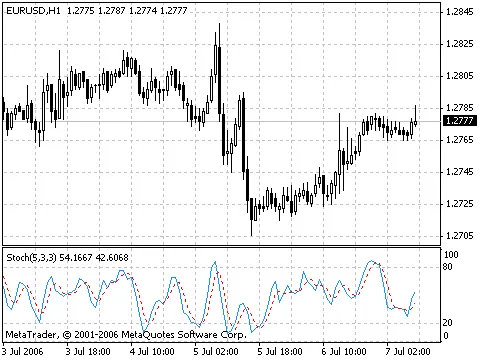
This indicator is represented by two lines: the main line, known as %K, and the second line, %D, which is a Moving Average of %K. Typically, you'll see the %K line as a solid line and the %D line as a dotted line.
There are a few effective ways to interpret the Stochastic Oscillator. Here are three popular strategies:
Buy Signal: When either the %K or %D line dips below a certain level (like 20) and then climbs back above it.
Sell Signal: When the Oscillator climbs above a specific level (like 80) and then drops back below it.Crossover Strategy: Look for buy opportunities when the %K line crosses above the %D line, and sell when the %K line crosses below the %D line.
Divergence Detection: Watch for instances where prices are hitting new highs but the Stochastic Oscillator fails to reach previous highs. This can indicate a potential reversal.
How to Calculate the Stochastic Oscillator
The Stochastic Oscillator has three key variables:
%K periods (Pk): This is the number of time periods used in the %K calculation, with a default of 5.
%K Slowing Periods (Sk): This controls the internal smoothing of %K. A value of 1 is considered fast, while a value of 3 is slow. The default is 3.
%D periods (Pd): This is the number of time periods used to calculate the moving average of %K, with a default of 3.
The formula for calculating %K is:
%K = 100 * SUM (CLOSE - MIN (LOW, Pk), Sk) / SUM (MAX (HIGH, Pk) - MIN (LOW, Pk)), Sk)
Where:
- CLOSE: Today's closing price;
- MIN (LOW, Pk): The lowest low over the last Pk periods;
- MAX (HIGH, Pk): The highest high over the last Pk periods;
- SUM (CLOSE - MIN (LOW, Pk), Sk): The cumulative value of CLOSE - MIN (LOW, Pk) for the Sk period;
- SUM (MAX (HIGH, Pk) - MIN (LOW, Pk)), Sk: The cumulative value of MAX (HIGH, Pk) - MIN (LOW, Pk) for the Sk period.
The %D moving average is calculated with the following formula:
%D = SMA (%K, Pd)
Where:
- Pd: The smoothing period for %K;
- SMA: The Simple Moving Average.
Learn More
For a deeper dive into the Stochastic Oscillator, check out the full description available in the Technical analysis: Stochastic Oscillator.




Comments 0