
The Momentum technical indicator is a powerful tool that measures how much a security’s price has changed over a specific time frame.
Traders often use the Momentum indicator in two primary ways:
- As a trend-following oscillator: Similar to the Moving Average Convergence/Divergence (MACD), you can buy when the indicator hits a low and starts to rise, and sell when it peaks and begins to drop. To help identify these turning points, consider overlaying a short-term moving average of the Momentum indicator itself.
If the Momentum indicator spikes to extremely high or low levels compared to its historical values, it usually suggests that the current trend will continue. For instance, if you see the Momentum reaching a peak and then turning down, it’s likely the prices will continue to rise before eventually correcting. However, always wait for price confirmation before making your move (for example, if prices peak and then start to drop, wait for a clear downward trend before selling).
- As a leading indicator: This approach suggests that market tops are often marked by rapid price increases (when traders are overly optimistic) and bottoms by swift declines (when fear drives traders to exit). While this holds true in many cases, be mindful that it’s a broad generalization.
As the market peaks, the Momentum indicator typically climbs sharply before falling off, creating a divergence from continued upward or sideways price movement. Conversely, at market bottoms, Momentum may drop sharply only to begin rising ahead of the price itself. These divergences between the indicator and price can be significant signals.
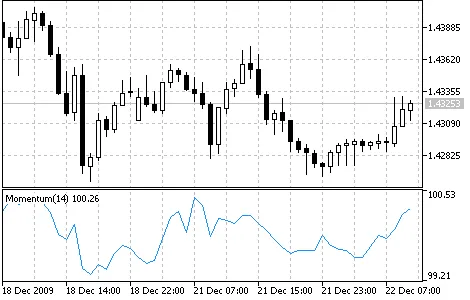
How to Calculate Momentum:
Momentum is calculated as a ratio of today’s price to the price from several periods ago.
MOMENTUM = CLOSE (i) / CLOSE (i - n) * 100
Where:
- CLOSE(i): The closing price of the current bar;
- CLOSE(i-N): The closing price from N periods ago.




Comments 0