
The Brooky Trend Strength Indicator is an invaluable tool for traders looking to gauge the strength of a trend and determine whether a currency pair is trending or ranging.
This indicator measures strength on a scale from below 0 heading upward. Unlike linear directional indicators, the Brooky Indicator uses colors to indicate direction while the slope indicates strength. A reading of 0 signifies a ranging market, while a movement above 0 indicates a trending market. It operates based on the variance between the Average True Range (ATR) and Standard Deviation (StdDev) over the same period, utilizing smoothing arrays for accuracy. Sensitivity is pip-based, reflecting the minimum movement between the highest high and lowest low across your selected bars, typically the last 5. This helps filter out minimal movements, presenting lighter colored bars that often signal early signs of reversal or consolidation before trend continuation.
Here's how to interpret the indicator:
- Trend Direction: Red indicates a downtrend, while blue signals an uptrend.
- Resistance to Trend:
- Pink indicates light downward pressure.
- Light blue indicates upward pressure.
The settings are similar to the MACD, with Slow, Fast, and Signal settings. Adjust the resistance pressure according to your preference, which may vary for each currency pair—1 for EUR/USD and up to 100 for USD/JPY. It's helpful to plot against historical data to visualize the pale color levels that suit your trading style.
For enhanced insights, consider placing a MACD with the same settings on your chart. This can provide complementary confirmations of the trend.
Key Areas to Watch
- Extreme Power Tops: Watch for a reverse color at the peak of a strong red downtrend, where light blue may appear. If only a few bars show light blue, the trend is likely to continue despite the temporary resistance.
- End of a Trend: A trend is likely over when the power line increases and shows more opposite colors, indicating a reversal.
- Ranging Market: A messy power struggle often emerges when the power line dips below 0, accompanied by alternating colors. It's wise to wait for a clear breakout.
- Ranging to Trending: Ranging concludes when a gentle slope with more developed color patterns starts to rise towards 0. Be cautious of sharp, near-vertical breakouts, as these tend to be short-lived.
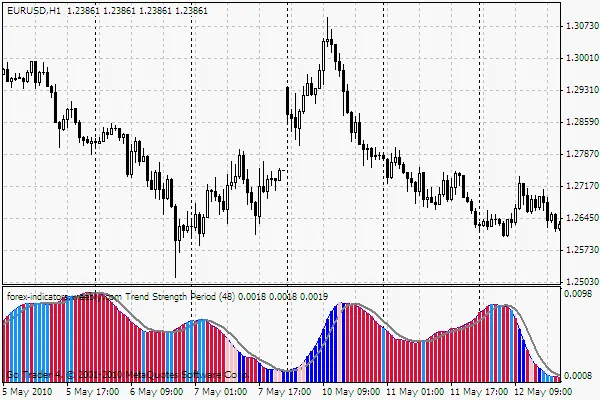
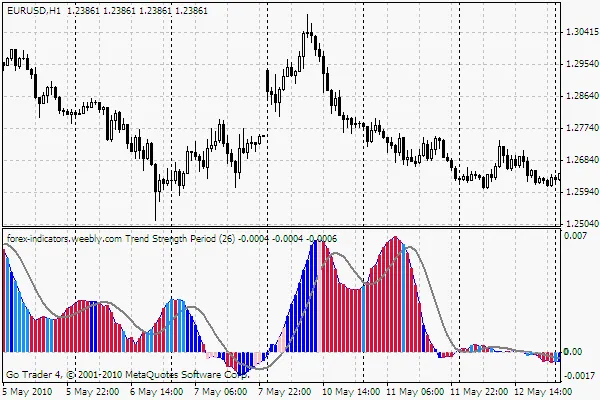
For in-depth analysis, longer period settings, like 48 on a 1-hour chart, can offer valuable insights. Experimenting with settings can also serve as an effective scalp confirmation when used alongside marked support and resistance levels. Below are two charts showcasing different settings to help illustrate the differences.
Happy trading!
Related Posts
- Unlocking MetaCOT 2: Your Ultimate CFTC Indicator Toolkit for MT4
- Unlocking the Power of Master Tools for MetaTrader 4
- Mastering the Open Range Breakout Indicator for MetaTrader 5
- Visualize Current Trends Across All Time Frames with This MetaTrader 4 Indicator
- Unlock Trading Insights with Volume Profile + Range v6.0 for MetaTrader 5