
When it comes to trading, understanding volatility is key. There are plenty of ways to measure how much a market is moving, and one effective method is to calculate the standard deviation of returns over a specific time period. You might notice that short-term volatility—say over 6 days—can often be linked to longer-term volatility, like over 100 days. This is where our volatility indicator comes into play, as it helps us understand the relationship between short-term volatility Vol_short and long-term volatility Vol_long.
How to Calculate Volatility Changes
Here's a straightforward formula to calculate the change in volatility:
Vol_change=Vol_short/Vol_long |
|---|
Now, it’s important to note that the standard deviation here isn’t calculated from the difference in closing prices. Instead, it’s derived from the logarithmic correlation between today’s closing price and that of the previous day. To put it simply, the formula looks like this:
Mom[i]=Close[i]/Close[i+1]
From here, you can calculate the volatility:
Vol_k=Std(Mom,k)
where k represents the period over which you’re measuring volatility changes.
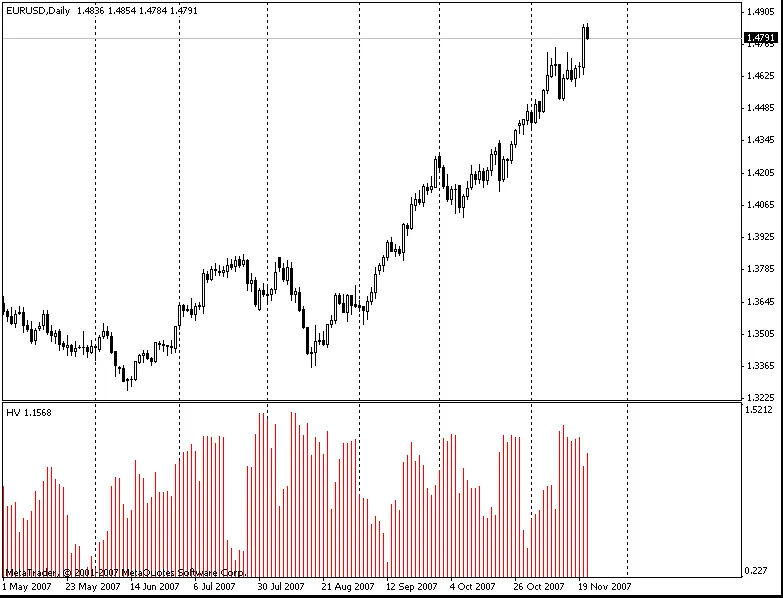
Being aware of these changes can significantly enhance your trading strategy. So, keep an eye on both short and long-term volatility to make more informed trading decisions!




Comments 0