
Author:
Originally researched by John F. Ehlers, as detailed in his book "Cybernetic Analysis for Stocks and Futures" (2004) ISBN: 0-471-46307-8.
The Two Pole Super Smoother Indicator, inspired by Ehlers' work, has been skillfully coded by Witold Wozniak (www.mqlsoft.com).
Further contributions and enhancements were made by Julien Loutre (zenhop).
So, what’s the deal with the Two Pole Super Smoother Indicator? It’s a fantastic tool for assessing trends and serves as a solid alternative to the regular moving average. However, it’s not the best at pinpointing the major cycle turning points.
To amp up its effectiveness, I’ve transformed the Super Smoother Indicator into a smoothed oscillator.
This new oscillator does a stellar job of identifying most cycle turning points while filtering out that annoying residual noise.
To tackle the noise issue, I employed Ehlers' Instantaneous Trendline Filter. This filter is brilliant at reducing noise while keeping lag to a minimum.
Because the math has been tweaked to focus on Open prices, this indicator won’t retrace, which is a huge advantage.
Lag:
Keep in mind that the original Two Pole Super Smoother Indicator does have a slight lag, which is proportional to its Cutoff Period. However, since this version is based on Open prices (to avoid retracements), it adds one bar of lag.
Additionally, the Instantaneous Trendline Filter contributes a bit of lag too, but it shouldn’t exceed two bars. So, steer clear of using this indicator for cycles shorter than 10 bars.
If you’re trying to catch 5-bar cycles on the H1 timeframe, consider using this indicator on M1 or M5 with a larger Cutoff period. The additional data from smaller timeframes lets you trade those short cycles effectively.
Take a look at the screenshot below to see how the oscillator accurately identifies the turning points of most cycles.
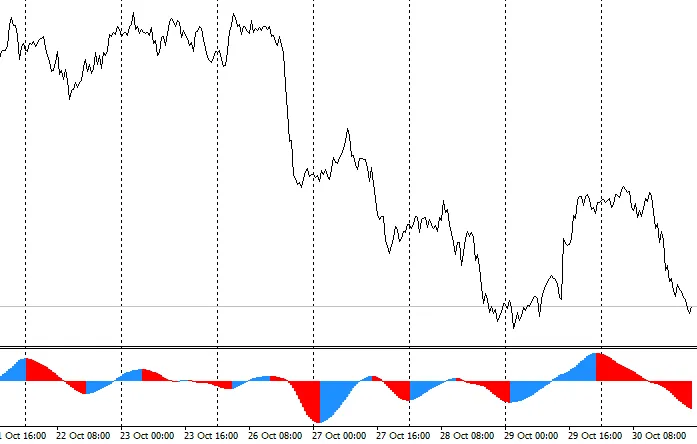
EURUSD M30 with CutOff=48 (24 hours, daily cycle) and alpha=0.07
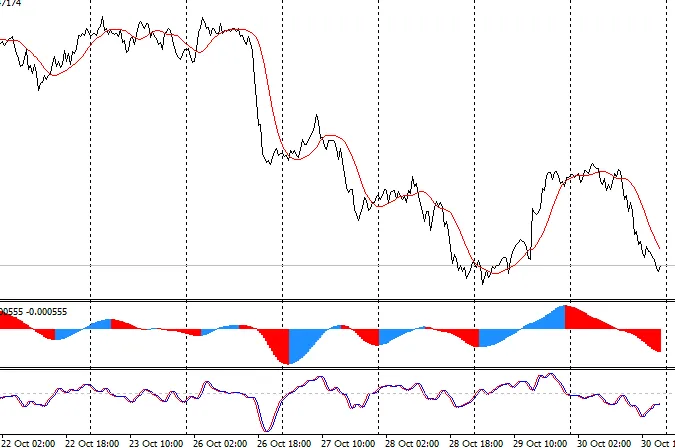
Ehlers' CyberCycle allows you to evaluate the quality of the signal.
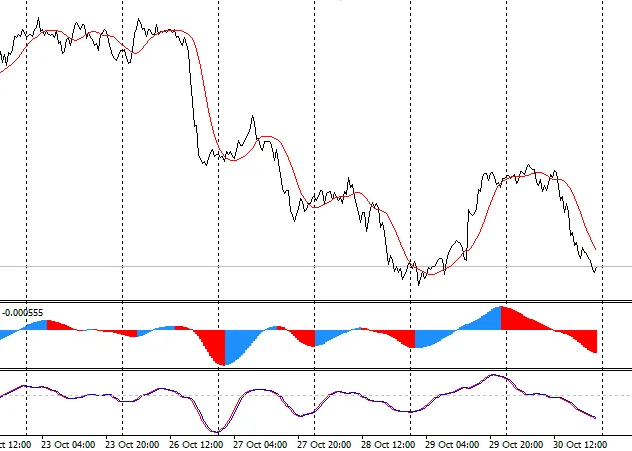
Ehlers' CG also allows you to evaluate the quality of the signal (Period=24 (half the target cycle's period))
Recommendations:
- This indicator can be quite accurate, but remember it’s not magic. Always confirm signals with other indicators (DSP indicators work well).
- Ehlers' CyberCycle is a fantastic filter for signals. Just make sure to use the same alpha in both indicators.
- Ehlers' CG (Center of Gravity) is another great tool for filtering signals. Use CG's period equal to the Oscillator's Cutoff divided by 2.
- While using an adaptive indicator (like Adaptive CyberCycle or Adaptive CG) can be beneficial, keep in mind that they may not sync up with this indicator, potentially leading to extra noise.
- This indicator shines when detecting cycles of 30 bars or longer. Its accuracy can drop when you try to use it for shorter cycles.
Related Posts
- Unlocking MetaCOT 2: Your Ultimate CFTC Indicator Toolkit for MT4
- Unlocking the Power of Master Tools for MetaTrader 4
- Unlock Trading Insights with Volume Profile + Range v6.0 for MetaTrader 5
- Predicting Future Prices with Neural Networks: Your Guide to BPNN
- ID Lite Info MA: A Comprehensive Indicator for MetaTrader 5