
Fractal Adaptive Moving Average (FrAMA) is a cutting-edge technical indicator developed by John Ehlers that you can use in MetaTrader 5. It’s designed to help traders like us make sense of price movements and identify trends effectively.
The beauty of FrAMA lies in its foundation on the Exponential Moving Average (EMA), with a twist. Instead of a static smoothing factor, FrAMA dynamically calculates this based on the current fractal dimension of the price series. What does this mean for us? Simply put, it allows us to ride strong trends while also adapting during periods of price consolidation.
Just like with any moving average, you can apply all sorts of analysis techniques to FrAMA.
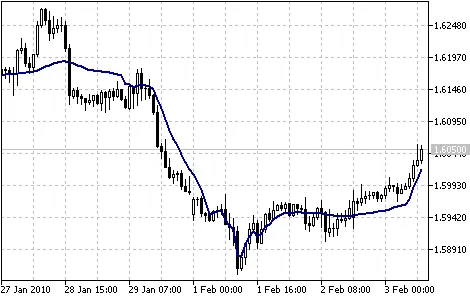
Fractal Adaptive Moving Average Indicator
How It's Calculated:
FRAMA(i) = A(i) * Price(i) + (1 - A(i)) * FRAMA(i-1)
Where:
- FRAMA(i) - the current value of FrAMA;
- Price(i) - the current price;
- FRAMA(i-1) - the previous value of FrAMA;
- A(i) - the current factor of exponential smoothing.
The exponential smoothing factor is calculated using the following formula:
A(i) = EXP(-4.6 * (D(i) - 1))
Where:
- D(i) - the current fractal dimension;
- EXP() - the exponent function.
To understand how this works, consider that the fractal dimension of a straight line is 1. If D = 1, then A = 1, meaning that during straight-line price movements, the formula simplifies to:
FRAMA(i) = 1 * Price(i) + (1 - i) * FRAMA(i-1) = Price(i)
In this case, the indicator tracks the price exactly.
On the other hand, if we’re looking at a more complex scenario, the fractal dimension for a plane is 2. Here, if D = 2, we find that the smoothing factor A becomes quite small (around 0.01) during strong, jagged price movements. This effectively behaves like a 200-period simple moving average, giving us a nice slowdown during volatile periods.
Now, let’s break down the formula for the fractal dimension:
D = (LOG(N1 + N2) - LOG(N3))/LOG(2)
This is calculated using another formula:
N(Length,i) = (HighestPrice(i) - LowestPrice(i))/Length
Where:
- HighestPrice(i) - the highest price over the last Length periods;
- LowestPrice(i) - the lowest price over the last Length periods.
The values N1, N2, and N3 are defined as follows:
N1(i) = N(Length,i)
N2(i) = N(Length,i + Length)
N3(i) = N(2 * Length,i)




Comments 0