
Have you ever wished for a tool that helps you pinpoint market movements more accurately? Enter the DailyPivot_Shift indicator! This nifty tool lets you calculate key levels based on the start of the trading day in your local time zone—no more relying on server time. For example, if you're trading in a GMT-8 zone, you’ll be able to tailor your analysis to suit your schedule.
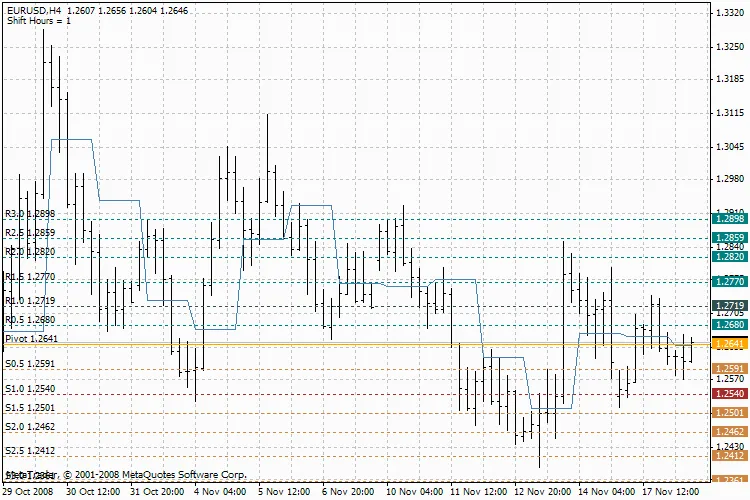
The DailyPivot Points indicator is a game-changer. Unlike other tools that often lag behind the market, this one crunches the data from the previous day to help forecast short-term trends. It gives you actionable insights into where the market might head next!
So, what exactly is a Pivot Point (PP)? Think of it as the equilibrium level where the price tends to hover throughout the day. By taking the previous day’s High, Low, and Close, you can compute a total of 13 levels for shorter timeframes. These include the balance point, 6 resistance levels, and 6 support levels, all termed as reference points. Understanding these reference points allows you to easily identify shifts in short-term trends.
Among these, the most crucial are:
- Pivot Point Level
- Resistance1 (RES1.0)
- Support1 (SUP1.0)
When the price dances between these levels, you’ll often notice significant breaks or even reversals.
So, what can you expect from the DailyPivot Points indicator?
- It forecasts the range of price fluctuations.
- It shows potential stopping points for price movements.
- It indicates possible turns in price direction.
If the market opens above the pivot point, consider it a green light for a long position. Conversely, if it opens below, it might be time to think short.
Using pivot points is all about tracking and identifying potential reversals or breakouts as prices hit resistance (RES1.0) or support (SUP1.0). When prices reach those further levels—like RES2.0, RES3.0, or SUP2.0, SUP3.0—you'll often find the market is either overbought or oversold, making those levels prime exit points.




Comments 0