
If you're looking to stay ahead of the game in trading, the Daily Pivot Points indicator is a tool you don't want to overlook. Unlike many other indicators that lag behind, Daily Pivot Points give you a clear forecast of potential market movements.
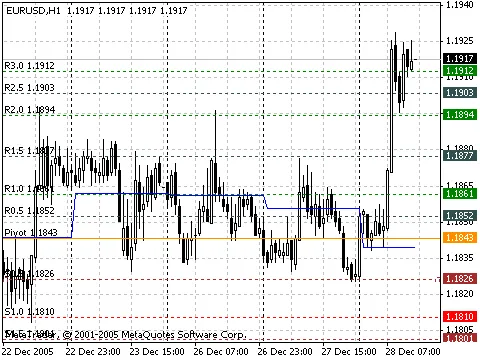
This handy indicator calculates reference points based on the previous day’s trading data, helping you identify short-term trends for the current day. The key concept here is the Pivot Point (PP), which acts as a balance point where prices tend to gravitate throughout the day. By using the previous day’s High, Low, and Close values, you can derive 13 different levels: the Pivot Point itself, 6 resistance levels, and 6 support levels. Collectively, these are known as reference points, and they can make spotting short-term trend changes a breeze. The three most critical values to watch are the Pivot Point, Resistance1 (RES1.0), and Support1 (SUP1.0).
As price fluctuates between these reference levels, you might notice some interesting patterns, including potential reversals or breakouts.
So, what exactly does the Daily Pivot Points indicator do?
It forecasts the range of price fluctuations.
It indicates potential stopping points for the price.
It highlights possible reversal points in price direction.
When the market opens above the Pivot Point level, it’s often a solid signal to consider going long. Conversely, if it opens below the Pivot Point, it might be a day to think about short positions.
The strategy here is to monitor and identify likely reversals or breakouts at the resistance (RES1.0) and support (SUP1.0) levels. Typically, by the time the price hits the RES2.0, RES3.0 or SUP2.0, SUP3.0 levels, the market is either overbought or oversold, making these great exit points.
How to Calculate Daily Pivot Points
Using the previous day’s HIGH, LOW, and CLOSE, you can easily generate the following levels:
- Pivot Point (PP)
- Resistance1 (RES1.0)
- Resistance2 (RES2.0)
- Resistance3 (RES3.0)
- Support1 (SUP1.0)
- Support2 (SUP2.0)
- Support3 (SUP3.0)
- Intermediate values: RES0.5, RES1.5, RES2.5, SUP0.5, SUP1.5, SUP2.5
To put it simply, you’re projecting the highest and lowest prices of the previous day into the future.
PP = (HIGH + LOW + CLOSE) / 3
RES1.0 = 2*PP - LOW
RES2.0 = PP + (HIGH - LOW)
RES3.0 = 2*PP + (HIGH – 2*LOW)
SUP1.0 = 2*PP – HIGH
SUP2.0 = PP - (HIGH – LOW)
SUP3.0 = 2*PP - (2*HIGH – LOW)
RES0.5 = (PP + RES1.0) / 2
RES1.5 = (RES1.0 + RES2.0) / 2
RES2.5 = (RES2.0 + RES3.0) / 2
SUP0.5 = (PP + SUP1.0) / 2
SUP1.5 = (SUP1.0 + SUP2.0) / 2
SUP2.5 = (SUP2.0 + SUP3.0) / 2
Where:
- HIGH — the highest price of the previous day;
- LOW — the lowest price of the previous day;
- CLOSE — the close price of the previous day;
- PP — pivot point (the typical price of the previous day);
- RES0.5, RES1.0, RES1.5, RES2.0, RES2.5, RES3.0 — reference points (resistance levels);
- SUP0.5, SUP1.0, SUP1.5, SUP2.0, SUP2.5, SUP3.0 — reference points (support levels).




Comments 0