
Hey there, fellow traders! Today, I’m diving into the SilverTrend Duplex System designed for MetaTrader 5. This nifty tool features two identical trading systems tailored for both long and short positions, making it incredibly versatile.
Understanding the Setup
What’s cool about this setup is that you can configure it in various ways all within one Expert Advisor (EA). The input parameters are neatly categorized into two groups:
- Long Position Parameters: These are indicated by parameters starting with “L”.
- Short Position Parameters: These use parameters beginning with “S”.
//+----------------------------------------------+//| Input parameters for long trades   |//+----------------------------------------------+
magic numberinputuint    L_Magic=777;          //L magic numberinputdouble  L_MM=0.1;             //L share of deposit per tradeinput MarginMode L_MMMode=LOT;      //L lot setting mode//+----------------------------------------------+//| Input parameters for short trades  |//+----------------------------------------------+inputuint    S_Magic=555;          //S magic numberinputdouble  S_MM=0.1;             //S share of deposit per tradeinput MarginMode S_MMMode=LOT;      //S lot setting mode
Each of these systems operates independently with its unique magic number. This is crucial, as real financial markets can be quite asymmetric. You often need different parameters for trading during uptrends versus downtrends. So, it’s best to start by testing one system at a time. Just flip the relevant switches to disable the other system.
inputbool L_PosOpen=true; //L permission to enter long positionsinputbool L_PosClose=true; //L permission to exit long positions
Once you’ve got that sorted, you can repeat the process for the short trading system.
Important Setup Notes
To get your EA up and running, make sure the compiled SilverTrend.ex5 indicator is located in the <terminal_data_directory>\MQL5\Indicators folder.
For the tests I ran below, I utilized the EA’s default input parameters, and I didn’t include Stop Loss or Take Profit during testing.
Testing Results
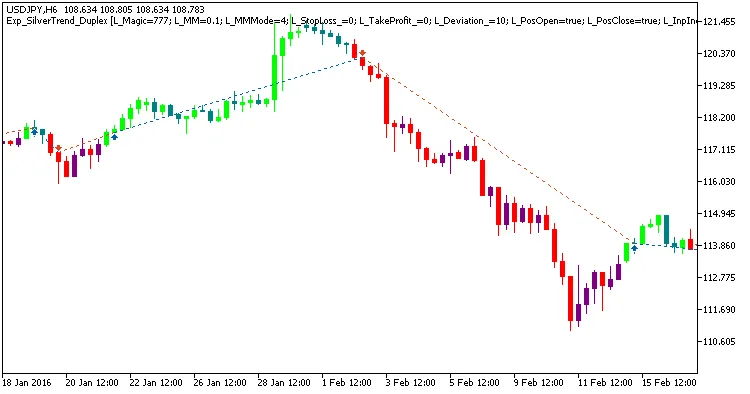 .
.
Fig.1. Examples of deals on the chart with symmetrical settings.
Here are the testing results for USDJPY on the H6 timeframe over the year 2016:
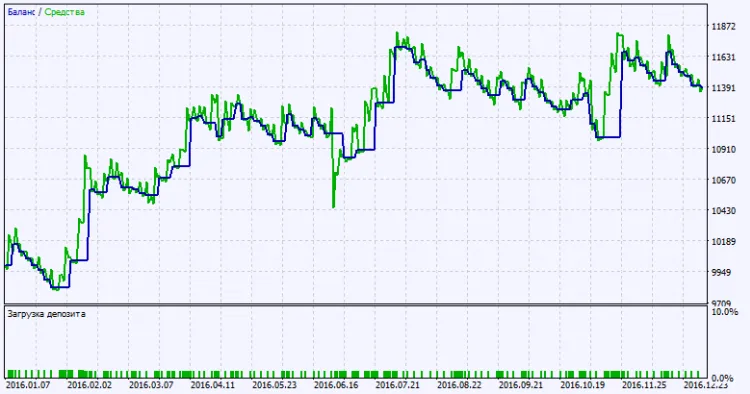
Fig.2. Testing results chart.
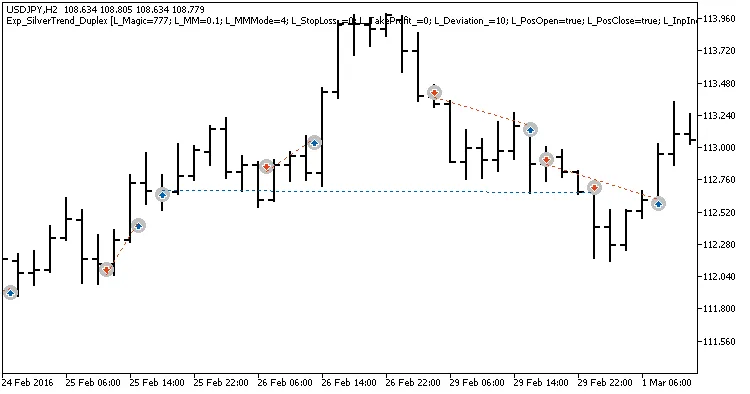
Fig.3. Examples of deals on the chart with non-symmetrical settings.




Comments 0