
The Chaikin Volatility Indicator is a handy tool for traders, measuring the spread between the highest and lowest prices over a specific timeframe.
What sets it apart from other indicators, like the Average True Range (ATR), is that it doesn’t consider price gaps. Instead, it focuses solely on the amplitude between the high and low prices.
According to Chaikin’s perspective, a surge in the volume indicator over a short period suggests that prices are nearing their lows—think of it as panic selling. Conversely, a decline in volatility over a longer stretch typically indicates that prices are peaking, which can often happen in a mature bull market.
To enhance your trading strategy with the Chaikin Volatility Indicator, it’s wise to use Moving Averages and Envelopes for confirmation of its signals.
- A peak in the indicator often occurs when market prices retreat from a recent high and the market flattens out.
- A flat market indicates low volatility, and breaking out of this sideways movement usually doesn’t come with a significant increase in volatility.
- As prices break above previous highs, you can expect volatility to rise.
- The Chaikin indicator will continue to climb until a new price peak is established.
- If you see a rapid drop in volatility, it could signal that the movement is slowing down, hinting at a potential reversal.
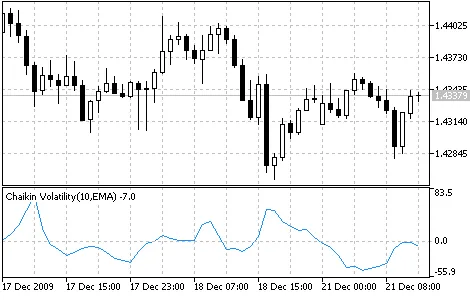
Chaikin Volatility Indicator
Calculation:
H-L (i) = HIGH (i) - LOW (i)
H-L (i - 10) = HIGH (i - 10) - LOW (i - 10)
CHV = (EMA (H-L (i), 10) - EMA (H-L (i - 10), 10)) / EMA (H-L (i - 10), 10) * 100
Where:
- HIGH (i) - maximum price of the current bar;
- LOW (i) - minimum price of the current bar;
- HIGH (i - 10) - maximum price of the bar ten positions back;
- LOW (i - 10) - minimum price of the bar ten positions back;
- H-L (i) - difference between the maximum and minimum price in the current bar;
- H-L (i - 10) - difference between the maximum and minimum price ten bars ago;
- EMA - exponential moving average.




Comments 0