
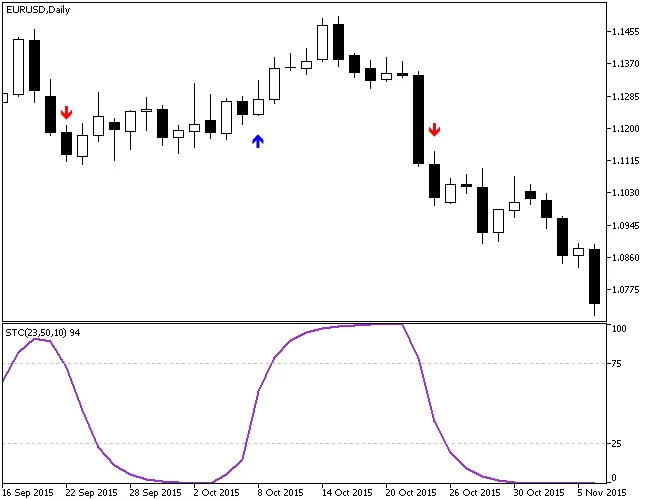
Schaff Trend Cycle (MT5 Indicator) — This unique cyclical oscillator is designed to enhance your trading strategy. Created by Doug Schaff, it operates by calculating the stochastic over a MACD line, effectively smoothing out the noise during trends and responding quickly to market changes. Schaff introduced this innovative approach back in 2008, based on the idea that currency trends move in cycles of acceleration and deceleration. The indicator values range from 0 to 100, with two main trigger levels set at 25 and 75. Plus, it comes with optional alerts, making it a handy tool for traders.
Input Parameters
Main Settings
- MAShort (default = 23) — This is the period for the fast moving average used in the MACD calculation. Remember, it should be shorter than MALong.
- MALong (default = 50) — This represents the period for the slow moving average in the MACD calculation. It should be longer than MAShort.
- Cycle (default = 10) — This indicates the length of the cycle in chart periods. Note that the effective cycle length is double because it calculates two stochastics in sequence.
Alerts
- ShowArrows (default = false) — Set to true if you want arrows to appear above or below the bars where signals are generated.
- UpColor (default = clrBlue) — This specifies the color of the bullish signal arrow.
- DownColor (default = clrRed) — This determines the color of the bearish signal arrow.
- ShowAlerts (default = false) — If set to true, a display alert will pop up when a signal is generated.
- SoundAlerts (default = false) — Set this to true to have a sound alert when a signal is triggered.
- EmailAlerts (default = false) — If enabled with true, an email alert will be dispatched upon signal generation.
- PushAlerts (default = false) — This sends a push notification when a signal is generated, if set to true.
Trading Strategy
The easiest way to utilize the Schaff Trend Cycle in your trading is straightforward: sell when the line dips below 75 and buy when it climbs above 25. However, to refine your signals and reduce false positives, Doug Schaff suggests a more nuanced approach: for a buy signal, the bar following the trigger bar (the one that crosses above 25) should close higher than the trigger bar’s high. Conversely, for a sell signal, the next bar should close lower than the trigger bar’s low. This method provides a more reliable confirmation of trend direction.




Comments 0