
On Balance Volume (OBV) is a popular momentum indicator that connects volume with price changes. Developed by Joseph Granville, it’s straightforward and effective.
Here’s how it works: if the close price of the current candle is higher than the previous one, we add the current volume to the OBV. Conversely, if the close price is lower, we subtract the current volume from the OBV. Simple enough, right?
The core idea behind OBV analysis is that changes in the OBV often happen before price changes. When you see the OBV rising, it indicates that smart money is flowing into the asset. Eventually, when the general public starts buying in, both the price and the OBV typically surge together.
However, if the price moves ahead of the OBV, that’s a signal for concern—this is known as a “non-confirmation.” You might see this at the peaks of bull markets (when prices rise before the OBV) or at the bottoms of bear markets (when prices fall before the OBV).
You can tell that OBV is in a rising trend when each new peak and trough is higher than the last. On the flip side, it’s in a downtrend when every peak and trough is lower. If the OBV is just hanging around without making significant highs or lows, it’s in a questionable trend.
Once a trend is established, it tends to stick around until something breaks it. There are two ways this can happen: the trend can switch from rising to falling or vice versa. The second way is if it shifts to a sideways trend and remains there for more than three days. For instance, if the OBV flips to a sideways trend for just two days before returning to a rising trend, it’s still considered to be in a rising trend.
When the OBV transitions to a rising or falling trend, that’s your breakout moment. Since OBV breakouts usually signal upcoming price breakouts, it’s a good idea to go long on OBV upside breakouts. Conversely, if you see a downside breakout on the OBV, it might be time to short. Hold onto your positions until the trend changes.
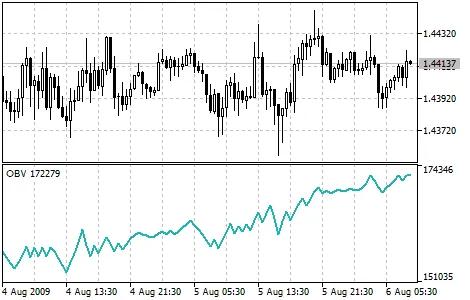
On Balance Volume indicator
Calculation:
If the current close price is higher than the previous one, then:
OBV (i) = OBV (i - 1) + VOLUME (i)
If the current close price is lower than the previous one, then:
OBV (i) = OBV (i - 1) - VOLUME (i)
If the current close price is equal to the previous one, then:
OBV (i) = OBV (i - 1)
Where:
- OBV (i) - value of the On Balance Volume indicator for the current period;
- OBV (i - 1) - value of the On Balance Volume indicator for the previous period;
- VOLUME (i) - volume of the current bar.




Comments 0