
The Chaikin Oscillator (CHO) is a powerful tool that traders can use to gauge market momentum. It's based on the difference between moving averages of the Accumulation/Distribution indicator, giving you insights into market strength.
This oscillator operates on three main principles:
- First: If a stock or index closes higher than its average price for the day (which you can find by calculating the average as [max + min] / 2), it indicates a day of accumulation. The closer the closing price is to the maximum for the day, the more aggressive the accumulation is. Conversely, if the closing price is below the average, it suggests distribution is taking place, with increased activity as the price approaches the day's low.
- Second: A steady rise in price should be accompanied by an increase in trading volume. Think of volume as the fuel that drives the market's growth. If prices rise but volume lags, it signals weakness—like trying to drive a car without enough gas. On the flip side, a price drop usually happens with low volume, often leading to panic selling by institutional investors. Thus, we typically see a volume increase before a price drop, followed by reduced volume and some accumulation when the market stabilizes.
- Third: The Chaikin Oscillator helps track the flow of money into and out of the market. By comparing volume dynamics with price movements, you can identify market peaks and troughs over both short and medium-term periods.
While there's no surefire method for technical analysis, it’s wise to use the Chaikin Oscillator alongside other indicators. This combo can enhance the reliability of your short- to medium-term trading signals. For instance, pairing it with Envelopes based on a 21-day moving average and an overbought/oversold indicator can yield better results.
The most critical signals occur when prices hit maximum or minimum levels—especially at overbought/oversold points—yet the Chaikin Oscillator fails to exceed its previous extremes, indicating a potential reversal.
- Signals that align with the medium-term trend are generally more trustworthy than those that go against it.
- Just because the oscillator confirms a new high or low doesn’t guarantee that prices will continue in that direction. I consider this occurrence fairly insignificant.
Another way to utilize the Chaikin Oscillator is by watching for changes in its direction as signals for buying or selling, provided these align with the overall price trend. For example, if a stock is on the rise and trading above its 90-day moving average, an upward turn of the oscillator in negative territory could be a buy signal (remember, the stock price needs to stay above that 90-day average).
On the other hand, if the oscillator turns down while above zero, that could signal a selling opportunity—again, just make sure the stock price is below the 90-day moving average.
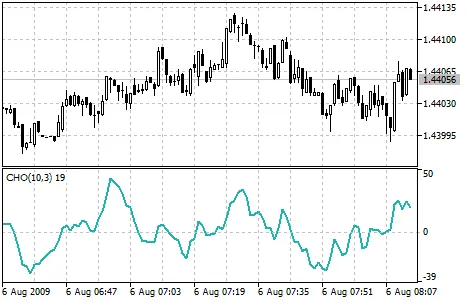
Chaikin Oscillator
Calculation:
To calculate the Chaikin Oscillator, you'll subtract a 10-period exponential moving average of the Accumulation/Distribution indicator from a 3-period exponential moving average of the same indicator.
CHO = EMA (A/D, 3) - EMA (A/D, 10)
Where:
- EMA - exponential moving average;
- A/D - value of the Accumulation/Distribution indicator.




Comments 0