
Bollinger Bands® are a popular technical indicator that many traders swear by. If you're using MetaTrader 5, you might find these bands particularly useful for gauging market volatility. Unlike Envelopes, which are set at a fixed distance from a moving average, Bollinger Bands adjust dynamically based on standard deviations from that average. This means they can widen or contract depending on market conditions, giving you a clear visual cue about volatility.
Typically plotted over your price chart, Bollinger Bands can also be added to your indicator chart. The key takeaway here is that prices generally hover between the upper and lower bands. One of the standout features of Bollinger Bands is their variable width: when the market is hot and prices are fluctuating wildly, the bands widen. Conversely, during quieter times, they tighten up, keeping prices within a narrower range.
Here are some essential traits of Bollinger Bands that every trader should keep in mind:
- Sudden price changes often occur after the bands have contracted, indicating a potential breakout.
- If prices breach the upper band, you might expect the current trend to continue.
- Conversely, if you see peaks and troughs breaking through the bands followed by movements within the bands, a trend reversal could be on the horizon.
- Typically, a price movement that starts at one band line tends to reach the opposite band.
This last observation can be incredibly helpful for predicting potential price targets.
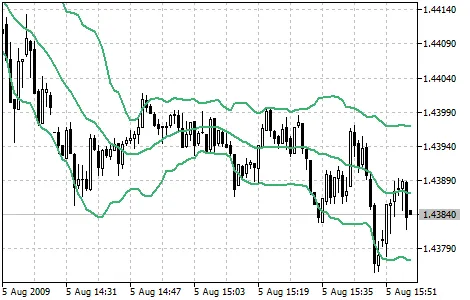
Bollinger Band Indicator
How to Calculate Bollinger Bands:
Bollinger Bands consist of three lines: the middle line (ML), which is a standard Moving Average. Here's how to calculate it:
ML = SUM (CLOSE, N) / N = SMA (CLOSE, N)
The upper band (TL) is positioned a set number of standard deviations (D) above the middle line:
TL = ML + (D * StdDev)
The lower band (BL) is simply the middle line minus the same number of standard deviations:
BL = ML - (D * StdDev)
Where:
- SUM (..., N) - the sum over N periods;
- CLOSE - the closing price;
- N - the number of periods used in the calculation;
- SMA - Simple Moving Average;
- SQRT - square root;
- StdDev - standard deviation:
StdDev = SQRT (SUM ((CLOSE — SMA (CLOSE, N))^2, N)/N)
For best results, many traders use a 20-period Simple Moving Average as the middle line, placing the upper and lower bands two standard deviations away. Keep in mind that using moving averages shorter than 10 periods might not yield significant insights.




Comments 0